
KITOEM · Custom Team OuterwearBeyond the final whistle.
One team, in every layer.
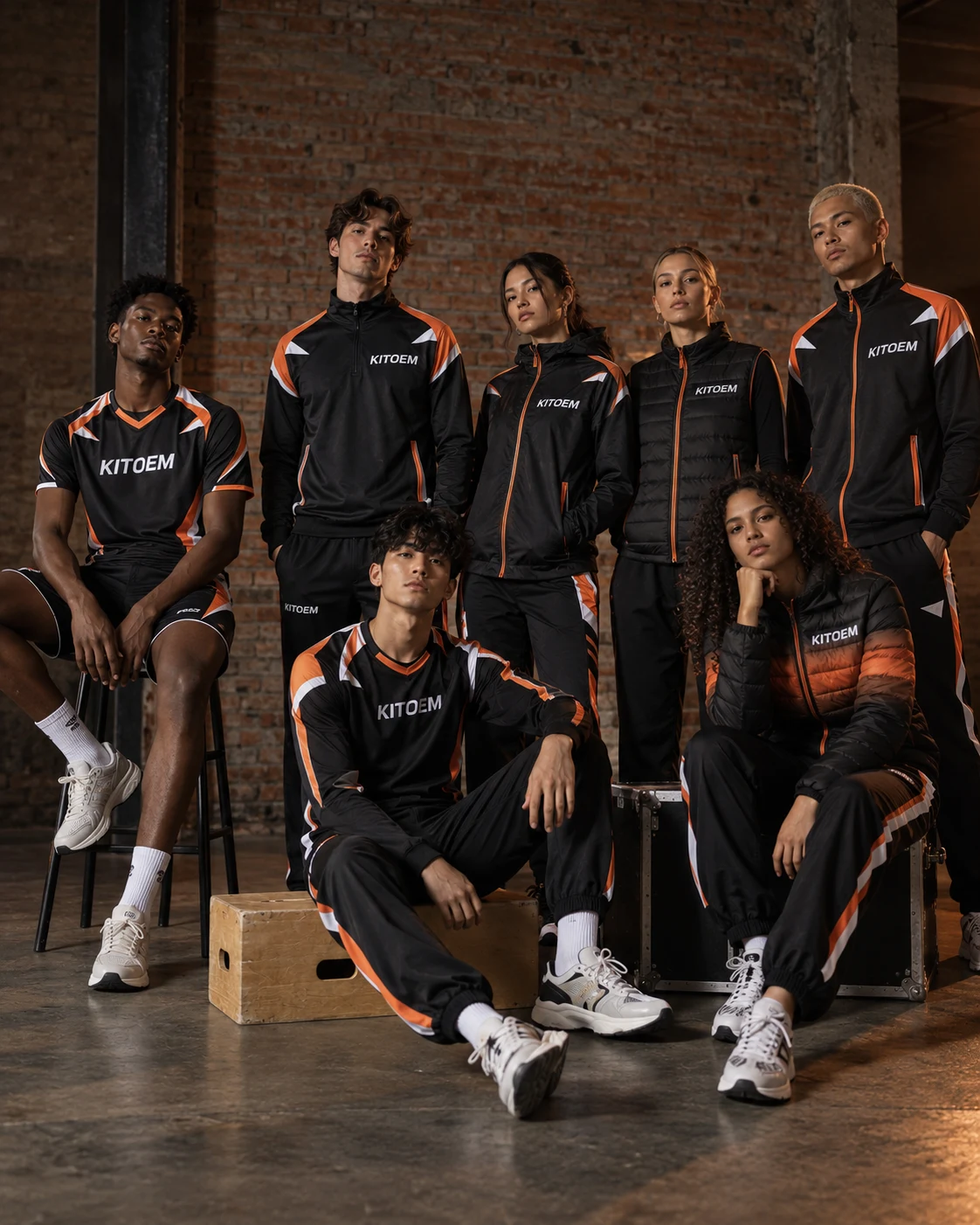
Team outerwear carries the club identity through warm-up, travel and the sideline. Explore track jackets, lightweight shells, short padded jackets, vests and long bench-coat records, alongside sport-specific layer directions.
Choose the wearing context first. Then define the shell, lining, insulation, closure and layering fit for the selected product.
Choose your starting point
Team Outerwear
Click an image to select or remove a reference.
Set quantities and notes in your enquiry.
42 references
Styles, sport options and design briefs. Counts include related options, not independent products or stock.
Complete reference index (42)
- Lightweight wind & rain jacketEnquiry style · KR-OW-001
- Basketball warm-up jacketSport-specific option · KR-OW-002
- Knitted travel zip layerCustom design brief
- Full-zip track jacketEnquiry style · KR-OW-002
- Basketball travel hoodieSport-specific option · KR-TM-002
- Running wind giletCustom design brief
- Short padded team jacketEnquiry style · KR-OW-003
- Outdoor-transfer shellSport-specific option · KR-OW-001
- Running weather shellCustom design brief
- Padded team vestEnquiry style · KR-OW-004
- Winter team jacketSport-specific option · KR-OW-003
- Short-sleeve batting jacketCustom design brief
- Long padded bench coatEnquiry style · KR-OW-005
- Basketball supporter hoodieSport-specific option · KR-TM-002
- Baseball dugout jacketCustom design brief
- Team hoodieEnquiry style · KR-TM-002
- Volleyball warm-up jacketSport-specific option · KR-OW-002
- Hooded walkout robeCustom design brief
- Baseball cage training jacketEnquiry style · KR-BS-003
- Volleyball travel hoodieSport-specific option · KR-TM-002
- Walkout jacketCustom design brief
- Road cycling wind gilet conceptEnquiry style · KR-CY-003
- Volleyball transfer shellSport-specific option · KR-OW-001
- Short walkout capeCustom design brief
- Volleyball winter travel jacketSport-specific option · KR-OW-003
- Warm-up zip jacketCustom design brief
- Volleyball fan hoodieSport-specific option · KR-TM-002
- Padded travel jacketCustom design brief
- Club warm-up jacketSport-specific option · KR-OW-002
- Cheer warm-up jacketCustom design brief
- Baseball track jacketSport-specific option · KR-OW-002
- Seasonal travel jacketCustom design brief
- Pickleball warm-up jacketSport-specific option · KR-OW-002
- Cycling rain-layer jacketCustom design brief
- Pickleball travel hoodieSport-specific option · KR-TM-002
- Cycling thermal jacketCustom design brief
- Pickleball weather-transfer shellSport-specific option · KR-OW-001
- Cycling team travel jacketCustom design brief
- Pickleball winter travel jacketSport-specific option · KR-OW-003
- Club Crew-Neck SweatshirtsCustom design brief
- Pickleball merchandise hoodieSport-specific option · KR-TM-002
- Travel track jacketSport-specific option · KR-OW-002
Construction, up close
The outside makes the statement. The inside completes the brief.
A jacket’s front image cannot show its full construction. Opening the garment reveals the lining, seam finish and decoration access; wearing it over the intended kit reveals its actual ease. Specify those decisions before the exterior artwork is finalised.
Choose the standing collar or hood direction for the use. Record hood adjustment, collar height, front opening, zip and any storm-flap request. Review these with the wearer’s head turning and the garment fully closed.
Try the layer over the intended shirt, midlayer or full training kit. Record chest, shoulder and sleeve measurements with that combination. A bench coat and an active warm-up jacket do not need the same ease or body length.
Define lined or unlined construction and pocket position, depth and closure. Establish how embroidery or another application is accessed so the inside finish is intentional. Approve the visible exterior and the inside of the garment together.
Review hem length while seated and standing, cuff closure and the lower opening. For a longer sideline layer, check stride and seated coverage. For a vest, review armhole fit over the chosen midlayer independently from sleeved jackets.
Choose for the wearer
Different days. Different layers.
Use the product record as the starting construction. The brief determines which material and trim details are developed or retained.
| Use & layer | Range starting point | Sample decisions |
|---|---|---|
| Active warm-up | Full-zip track jacket and sport-specific warm-up layers. | Movement ease, sleeve and cuff, front opening, pocket security and the relationship with warm-up pants. |
| Travel & team presentation | Track layer, hoodie or coordinated travel-jacket direction. | Seated comfort, layering allowance, pocket layout, label placement and consistent brand scale across the range. |
| Light outdoor transfer | Lightweight shell or gilet direction. | Shell/lining choice, hood/collar, closure, seam construction and any explicitly specified weather-test requirements. |
| Cold-season & sideline | Short padded jacket, padded vest or long bench coat. | Insulation and lining specification, body coverage, movement, cuff/hem finish and packing bulk. Warmth is evaluated for the chosen construction, not inferred from a padded image. |
Working with KITOEM · Xiamen, China
Brand presentation, down to the inside finish.
Outerwear is part of KITOEM’s own-production focus in Xiamen, supported by in-house printing, embroidery, label application and packing. The project team brings construction, brand placement and presentation into the same sample discussion.
A useful jacket specification connects the outside to the inside: shell and lining references, the selected insulation direction, pocket and closure details, decoration access and the finished labels. Retained Tech Packs, colour references, size charts, samples and production versions support agreed updates and reorders.
Explore our production & quality approach ↗A starting point, not three compulsory steps
Your brief sets the route.
Your specification.
Bring a Tech Pack, drawing or approved sample. Review measurements, material, construction, artwork and the production version for each product.
Explore this route ↗Your idea.
Bring the intended wearer, use and visual direction. Develop the product brief, then use the sample stage to close fit, cloth, trim and artwork decisions.
Explore this route ↗Your starting style.
Select a catalogue record. Identify which base details stay and which colours, marks or trims you want to change, before approving the applicable sample route.
Explore this route ↗From an attractive design to a usable specification
Review the jacket open, closed and in use.
For a tournament travel range, players may need light track jackets while coaches need longer sideline layers. Coordinate the colour and crest position, but retain different fabrics, lining, insulation, size splits and quantities for the two roles.
- Outside
- Front/back appearance, hood or collar shape, pocket alignment, logo position and proportions on the intended garment size.
- Inside
- Lining joins, seam finish, pocket bags, label placement and access for decoration. Do not approve only the front photograph.
- Worn together
- Fit over the actual base/midlayer; reach, sit and walk. Inspect sleeve length, cuff opening and hem coverage.
- Specification & packing
- Separate shell/lining/insulation and trim details, agreed test/report scope, size chart, folding/packing and dispatch requirements.
Add a cloth reference.
Keep the product decision yours.
Nine sample-card sources supplement the existing fabric library. Names and recorded specifications remain separate from physical sample identity. Select the garment and sample purpose before approving its cloth.
Composition and nominal mass are transcribed from the cards. Weight is shown in g/m²; the label printed on each card is kept below. These are fabric weights, not finished garment weights.
Double-face stretch fabric
氨纶双面布/健康布
- Declared composition
- 90% polyester / 10% elastane
- Nominal fabric weight
- 280 g/m²Original card label: 280g
- Card-described characteristics
- High colourfastness, contrast-colour suitability, anti-fuzzing and anti-pilling; structured handle.
- Supplier-listed uses
- Knitted outerwear, sports and leisure apparel.
- Source status
- Sample-card specification · not a performance test report
Cards 04 and 08 list the same nominal composition and weight, but remain two source records. 可撞白 is the supplier’s contrast-colour description, not a colour-migration guarantee.
Related catalogue source: KITOEM-FAB-C01 →The listed name, composition and weight align; physical correspondence is not confirmed.
Original card wording
- 成分
- 90%聚酯纤维 10%氨纶
- 特点
- 高色牢度,可撞白,抗起毛,抗起球,面料挺括
- 适用项目
- 针织外套,运动系列,休闲系列
280G double-face stretch fabric
280G氨纶双面布/健康布
- Declared composition
- 90% polyester / 10% elastane
- Nominal fabric weight
- 280 g/m²Original card label: 280g
- Card-described characteristics
- High colourfastness, contrast-colour suitability, anti-fuzzing and anti-pilling; structured handle.
- Supplier-listed uses
- Knitted outerwear, sports and leisure apparel.
- Source status
- Sample-card specification · not a performance test report
Cards 04 and 08 list the same nominal composition and weight, but their physical identity is not established. 可撞白 is a contrast-colour description, not a colour-migration guarantee.
Related catalogue source: KITOEM-FAB-C01 →The listed name, composition and weight align; physical correspondence is not confirmed.
Original card wording
- 成分
- 90%聚酯纤维 10%氨纶
- 特点
- 高色牢度,可撞白,抗起毛,抗起球,面料挺括
- 适用项目
- 针织外套,运动系列,休闲系列
Before the next step
A few useful answers.
Which outerwear records are available to start from?
The catalogue includes lightweight shell, full-zip track jacket, short padded jacket, padded vest and long bench-coat records, with other sport-specific layer directions. Each retains its own product detail and specification route.
Is every shell waterproof?
No. A product name or image does not establish waterproof performance. Specify intended conditions, fabric/finish, seams and closures, then agree the relevant test method and acceptance scope for the selected construction.
How do we compare a vest with a padded jacket?
Compare intended movement, coverage and layering first. Then specify shell, lining, insulation and opening details separately. A vest is not simply the jacket with the sleeves removed; the armhole fit also needs review.
Can embroidery be added after a jacket is assembled?
The application route depends on the selected garment and access. Review the placement, lining and inside finish before approval. If a proposed base style restricts access, discuss a suitable construction or application route rather than assuming it can be applied cleanly.
Should jacket sizes match match-shirt sizes?
Do not assume so. Fit the jacket over its intended layers and approve its own measurements and size breakdown. Matching size names across two products do not guarantee matching ease or coverage.
Another product in mind?
The range starts
with your requirements.
Share a product idea, drawing or reference. We accept complete sportswear, team apparel and non-protective supporting-product briefs, with each specification developed for its intended use.