
KITOEM · Custom MatchwearOne identity.
Every player.
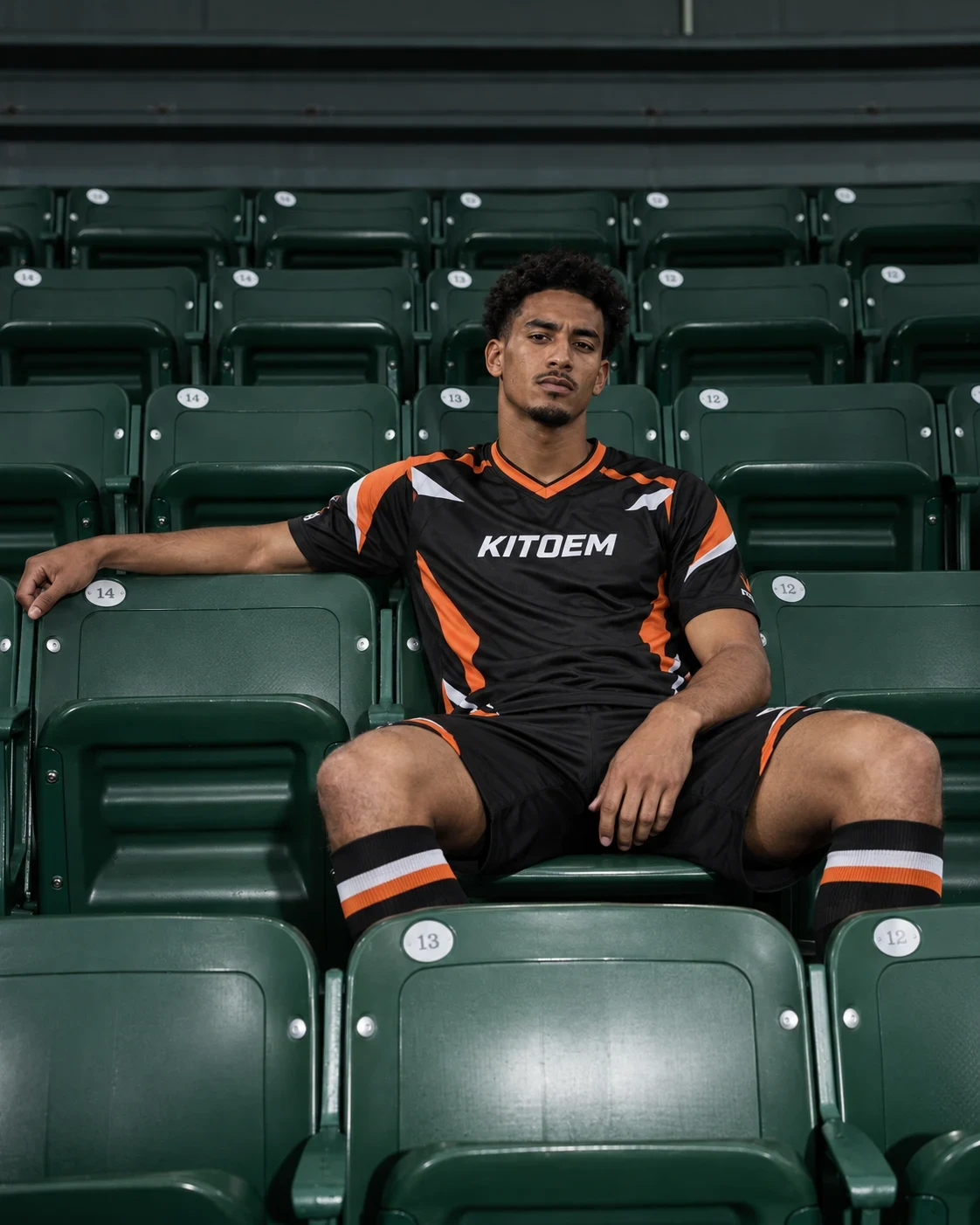
Custom matchwear by KITOEM: football shirts, basketball and volleyball jerseys, race singlets and specialist sport directions. Build the playing kit around your sport, wearer and team identity—not around a one-size-fits-all uniform.
Start with the garments below. Shirts and shorts retain independent sizing and quantities; supporting pieces join only when you choose them.
Choose your starting point
Matchwear
Click an image to select or remove a reference.
Set quantities and notes in your enquiry.
57 references
Styles, sport options and design briefs. Counts include related options, not independent products or stock.
Complete reference index (57)
- Football match shirtEnquiry style · KR-MT-001
- Basketball match jerseySport-specific option · KR-MT-002
- Running T-shirtCustom design brief
- Football match shortsEnquiry style · KR-MT-003
- Volleyball match shortsSport-specific option · KR-VB-002
- Running half tightsCustom design brief
- Baseball game pantsEnquiry style · KR-BS-005
- Baseball knicker pantsCustom design brief
- Basketball match jerseyEnquiry style · KR-MT-002
- Alternate-colour jerseySport-specific option · KR-MT-002
- Running crop tankCustom design brief
- Basketball match shortsEnquiry style · KR-BB-004
- Women’s match short directionSport-specific option · KR-VB-002
- Professional-style trunksCustom design brief
- Road bib tightsCustom design brief
- Running race singletEnquiry style · KR-RN-001
- Women’s basketball jersey directionSport-specific option · KR-MT-002
- Pickleball court tankCustom design brief
- Running race shortsEnquiry style · KR-RN-002
- Coordinated competition briefsCustom design brief
- MTB trail pantsCustom design brief
- Pickleball performance shirtEnquiry style · KR-PK-001
- Youth basketball jersey directionSport-specific option · KR-MT-002
- Pickleball court dressCustom design brief
- Pickleball performance shortsEnquiry style · KR-PK-003
- Cheer competition topEnquiry style · KR-CH-001
- Volleyball match jerseySport-specific option · KR-VB-001
- Long-sleeve competition topCustom design brief
- Cheer competition skirtEnquiry style · KR-CH-004
- Boxing competition vestEnquiry style · KR-BX-001
- Short-sleeve volleyball jerseySport-specific option · KR-VB-001
- Competition dressCustom design brief
- Boxing competition shortsEnquiry style · KR-BX-003
- Road cycling jersey conceptEnquiry style · KR-CY-001
- Long-sleeve volleyball jerseySport-specific option · KR-VB-001
- Unisex competition topCustom design brief
- Pickleball performance skortEnquiry style · KR-PK-002
- Volleyball match jerseyEnquiry style · KR-VB-001
- Libero contrast jerseySport-specific option · KR-VB-001
- Long-sleeve road jerseyCustom design brief
- Volleyball match shortsEnquiry style · KR-VB-002
- Button-front baseball jerseyEnquiry style · KR-BS-001
- Women’s volleyball jersey directionSport-specific option · KR-VB-001
- Road one-piece suitCustom design brief
- Road cycling bib shorts conceptEnquiry style · KR-CY-005
- Baseball pullover jerseyEnquiry style · KR-BS-002
- Youth volleyball jersey directionSport-specific option · KR-VB-001
- Short-sleeve MTB jerseyCustom design brief
- MTB trail shorts conceptEnquiry style · KR-CY-006
- MTB long-sleeve jersey conceptEnquiry style · KR-CY-002
- Pickleball performance shirtSport-specific option · KR-PK-001
- Long-Sleeve Goalkeeper JerseysCustom design brief
- Pickleball club poloSport-specific option · KR-TM-001
- Women’s pickleball shirt directionSport-specific option · KR-PK-001
- Long-sleeve court topSport-specific option · KR-RN-004
- Collared Football JerseysSport-specific option · KR-MT-001
- Long-Sleeve Match JerseysSport-specific option · KR-MT-001
Construction, up close
A kit is recognised at a distance. Its details are felt up close.
The crest, silhouette and number bring a team together. The collar, armhole and waistband determine how that identity sits on the wearer. Review the two together, on the same garment size, before the production version is signed off.
Choose the neckline for the sport and desired appearance: round, V, polo or a separate development direction. Record neck opening, collar depth and joining finish. Compare the approved shape on more than one size; the same visual proportion does not follow automatically from scaling a pattern.
Football sleeves and sleeveless court jerseys need different checks. Review sleeve length, underarm seam position and armhole coverage with the intended base layer. Reach overhead and across the body to identify pull, gaping or edge pressure before fixing the size chart.
Dimension the crest, sponsor, team name and player number from fixed garment reference points. Keep marks clear of binding, seams and the shorts waistband. Check front and back proofs, light-on-dark contrast and whether a graphic needs alignment across a side-panel join.
Agree shirt length for the intended tucked or untucked wear. Approve shorts waist, rise, inseam and leg opening separately. A player can need different top and bottom sizes; matching artwork does not make those measurements interchangeable.
Choose for the wearer
Same team. Different match requirements.
Use the sport filter for relevant records, then write the role and match context into the brief. The examples below explain design decisions, not automatic competition approval.
| Playing context | Decisions that matter | Approve on the sample |
|---|---|---|
| Football / soccer | Outfield and goalkeeper colour directions; collar and sleeve; independent match shorts and socks. | Crest/sponsor clearances, shirt coverage, separate shorts fit and goalkeeper contrast against the actual team colours. |
| Basketball | Jersey length, neckline depth, armhole opening, front/back numbering and shorts proportions. | Reach and coverage with the intended base layer; number placement on the chosen size; independently sized jersey and shorts. |
| Volleyball | Sleeveless, short- or long-sleeve direction; overhead reach; main-team and libero colour layout. | Binding comfort, body coverage while reaching and distinct libero artwork reviewed against the applicable event requirements. |
| Running & specialist sports | Race silhouette, court skort, baseball front opening, cycling position or cheer competition construction. | The sport-specific garment and wearer position. Start from the corresponding sport page rather than copying a football pattern. |
Working with KITOEM · Xiamen, China
Your team identity, connected to production.
KITOEM manufactures football kits and basketball uniforms in its own Xiamen facility. Printing, embroidery, label application and packing are handled in-house. One primary contact team connects the brief, sample confirmation and production arrangements, so garment construction and team identity are reviewed together.
For a matchwear project, the practical output is a controlled garment and artwork version: separate shirt/short specifications, identifiable role and colour directions, and an approved roster/packing reference. The same records support the next order without treating a previous cloth or size chart as an automatic substitute.
Explore our production & quality approach ↗A starting point, not three compulsory steps
Your brief sets the route.
Your specification.
Bring a Tech Pack, drawing or approved sample. Review measurements, material, construction, artwork and the production version for each product.
Explore this route ↗Your idea.
Bring the intended wearer, use and visual direction. Develop the product brief, then use the sample stage to close fit, cloth, trim and artwork decisions.
Explore this route ↗Your starting style.
Select a catalogue record. Identify which base details stay and which colours, marks or trims you want to change, before approving the applicable sample route.
Explore this route ↗From an attractive design to a usable specification
The matchwear approval set
For a club ordering home and alternate kits, keep each colourway and goalkeeper direction identifiable. Use one controlled player list, but give shirts, shorts and socks their own size and quantity columns. This avoids turning a coordinated visual into an ambiguous set order.
- Garment & size
- Separate shirt and shorts size charts, measurement points, agreed tolerances and a wearer-fit reference.
- Artwork & roster
- Authorised vector files, front/back/sleeve dimensions, player spelling, number and size. Freeze the roster version used for production.
- Colour & cloth
- Selected fabric reference and composition/weight, main and contrast colours, actual print or decoration reference and light-colour coverage.
- Packing & release
- Identify which pieces form each player pack, how mixed sizes are labelled, who approves the final version and the required dispatch/arrival milestones.
Before the next step
A few useful answers.
Is a matchwear reference a complete kit?
No. The product detail identifies the garment included. A football shirt, basketball jersey or volleyball jersey is not automatically supplied with shorts, socks or accessories. Select the pieces you need and keep each quoted unit explicit.
Can players choose different top and shorts sizes?
Yes—brief the two size breakdowns independently. Match the final packing list to each player, rather than assuming one size label fits both garments. The sample review closes the measurement chart for each product.
How do we specify names, numbers and sponsors?
Provide authorised artwork and a version-controlled roster. State dimensions and position on front, back and sleeves, plus the garment size used for the proof. Review artwork near seams and check contrast on the actual colourway.
Can the goalkeeper or libero use a separate design?
Yes. Keep that role as a separate artwork and garment direction within the project. Review construction, quantities and contrast against the relevant event requirements; a design preview is not a rules certificate.
Is 160 g/m² the standard for every match jersey?
No. The 160 g/m² polyester micro-mesh is recorded for one volleyball cooperation order. Other products use their selected material reference and approved specification; the case does not assign a universal fabric, minimum quantity or lead time.
Another product in mind?
The range starts
with your requirements.
Share a product idea, drawing or reference. We accept complete sportswear, team apparel and non-protective supporting-product briefs, with each specification developed for its intended use.