
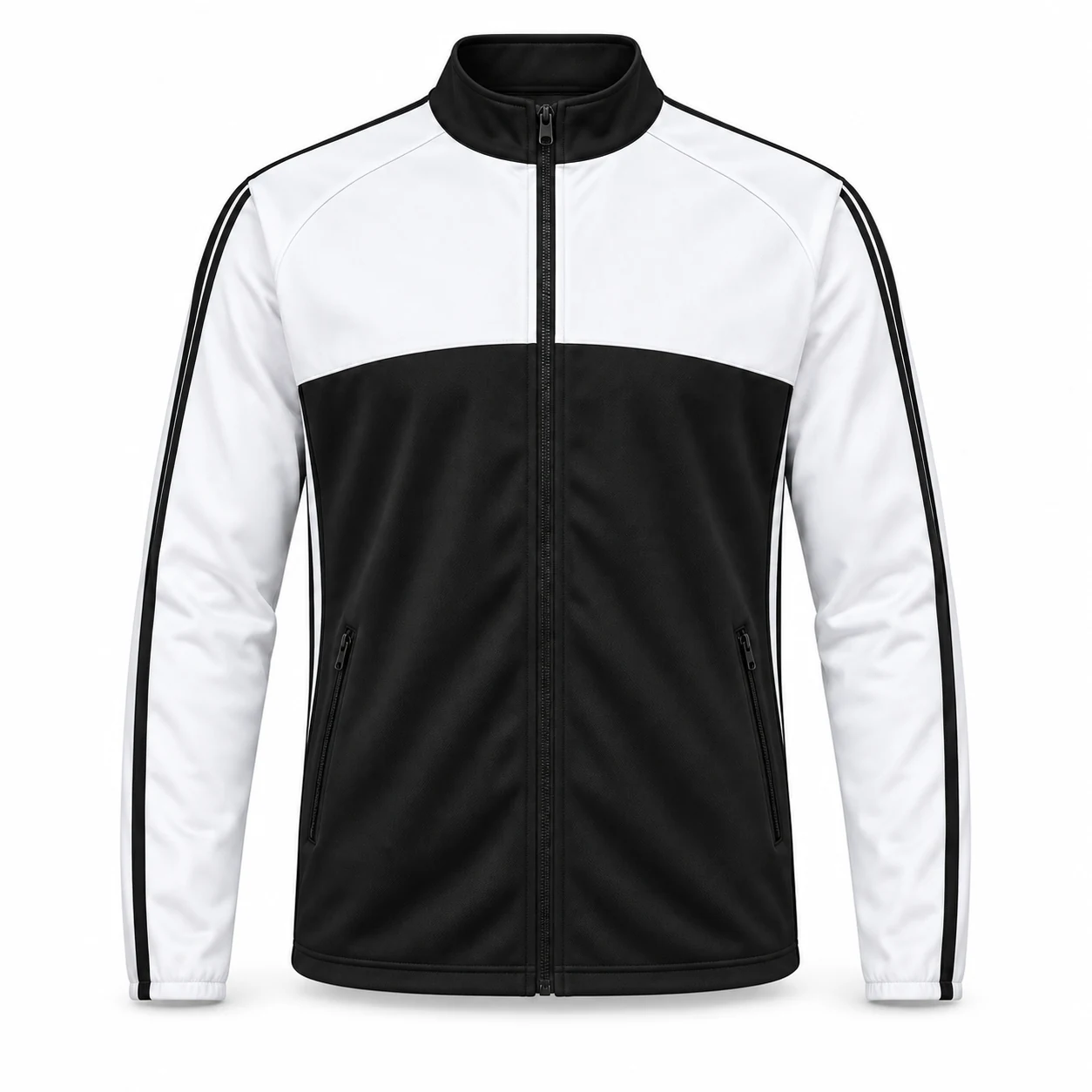
The decision in one paragraph
Approve team outerwear in stages. Use named references for shell, lining, zipper tape, pullers and trims, but do not treat a trim board as approval of the complete garment. Record which decisions require a wearable jacket and whether jacket and trouser reorders have separate minimums.
Create a trim and material list
Give every shell, lining, rib, zipper, puller, elastic, cord and label a named reference and colour approval method.
A standard trim may reduce custom development, but any effect on minimum or timing is confirmed for the exact product and colour.
Use the right sample level
| Evidence | Can support | Cannot approve alone |
|---|---|---|
| Swatch | Surface, shade and initial material selection | Fit, seam interaction or finished protection |
| Trim board | Hardware type, colour and early compatibility review | Jacket assembly, pockets or lining |
| Wearable sample | Fit, movement, operation and construction | Unrecorded bulk substitutions |
| Pre-production record | Final combination and corrections | Future orders with changed materials |
Review the complete garment in use
Check layering, reach, sitting, pocket access, zipper operation and hem or cuff behaviour on the intended wearer group.
Weather, insulation and waterproof claims require a defined specification and evidence; they are not inferred from a shell image or fabric name.
Keep jacket and trouser reorders separate
A tracksuit can share identity while jacket and trouser demand changes at different rates. Preserve quantities and product references for each item.
Ask whether the reorder minimum can be shared; do not assume the first-order programme carries forward unchanged.
Record production-ready substitutions
If temporary trims were used in a sample, list the production trim and require a controlled confirmation before release.
Attach the final trim list, sample disposition and open points to the quotation or purchase record.
Separate early selection from a production release
Treat sample stages as decisions, not a ceremonial sequence of photographs. A swatch can help choose a surface and shade; a trim board can identify a zipper tape, puller or elastic; the assembled jacket shows interactions among shell, lining, pockets and hardware. Record which parts of the decision each sample supports and which remain unresolved.
Coats’ zip application guidance calls for trials before bulk production. Apply that principle to the proposed jacket and its actual use, rather than borrowing a generic hardware specification. Check the intended closure, alignment, access and material interaction. Do not assume that a recognised component brand certifies the finished garment.
| Approval stage | Decision it can close | Required next record |
|---|---|---|
| Material reference | Named shell, lining or trim selection | Identity, shade and remaining product questions |
| Trim board | Hardware type and early colour coordination | Temporary versus intended production components |
| Wearable jacket | Fit, movement, pocket and closure interaction | Comments, accepted deviations and revision |
| Production-ready approval | Accepted complete specification and substitutions | Final references and named release owner |
Control temporary trims before they become permanent
A temporary zipper can make a development sample wearable while the intended component is being evaluated. Mark that substitution on the sample record. Say whether its colour, length, puller, tape or operating characteristics differ from the proposed production item, and which part of the sample the buyer is actually approving.
After the intended component is selected, decide whether a confirmation sample or another focused review is needed. That decision depends on the change, not on a universal promise that every substitution is harmless. A lining or pocket construction change can also reopen the assembled garment review. Keep a version-controlled final bill of materials with the accepted garment reference.
Make weather claims and reorders separate decisions
Illustrative planning scenario: a club accepts a standard trim colour instead of developing a bespoke shade. The supplier can explain the actual effect on that product’s quotation and sourcing; the website should not invent a lower minimum or shorter lead time. The choice still needs colour and assembled-product approval where relevant.
When a weather-related property is requested, define the test question and its scope. AATCC distinguishes spray repellency from hydrostatic-pressure resistance; neither name alone proves a jacket result. Keep jacket and trouser reorders separately identified, since demand and available materials can change by component. Common errors are releasing production from a trim-board photo, failing to list sample substitutions and assuming a first-order material is available indefinitely.
- Named shell, lining and every hardware reference
- Purpose and limits of each sample
- Temporary component list and proposed production replacement
- Wearable fit, movement, pocket and closure review
- Any weather-property evidence scoped to the sample
- Final approved version and reorder questions
What to confirm for your project
- Shell, lining and trim references
- Standard and custom hardware
- Purpose of each sample
- Wearable fit and movement review
- Product-specific minimums and reorder rules
- Approved production substitutions
MOQ, sampling conditions, production timing, exact material options and service scope are confirmed for the specific product and order. This guide does not replace a current quotation, approved sample or production specification.
Questions to carry into supplier review
- Can a temporary zipper approve colour but not operation?
- When does a lining change require a new sample?
- Are jacket and trouser quantities quoted separately?
Questions buyers ask next
Can a zipper-and-trim board replace the complete jacket sample?
It can support early hardware and colour selection, but it cannot show the jacket’s fit, pocket construction, lining or assembled zipper operation. Record those outstanding decisions and review the relevant complete garment.
Does accepting a standard trim colour guarantee a lower minimum?
No. It is a sourcing option whose actual cost, quantity and timing effect must be confirmed for the selected product. Do not convert a possible simplification into a universal commercial promise.
How should a temporary zipper be recorded on a sample?
Identify the temporary component, the intended production replacement and the differences. State which observations the sample approves and whether a confirmation review is needed once the actual component is available.
When can a lining change require renewed approval?
When it affects a decision such as assembly, fit, movement, pocket access or appearance. Record the proposed change and its effect rather than assuming the original wearable sample approves every future lining.
Must a tracksuit reorder contain equal jacket and trouser quantities?
Do not assume equality or a shared minimum. Keep both products and quantities visible and ask for current component-specific reorder terms, material references and any revised approval requirements.
Technical references and question evidence
- Technical referenceAATCC — Standard test methods: repellency, resistance and care
- Technical referenceASTM textile standards catalogue
- Technical referenceISO 8559-1:2017 — Anthropometric definitions for body measurement
- Technical referenceCoats — Zip application trials before bulk production
Technical references support the discussion method. Question evidence documents public discussion of an issue; it does not diagnose a KITOEM product or establish a test result.