
The decision in one paragraph
Choose sportswear fabric around the wearer, movement, garment fit and visual identity. KITOEM’s laboratory-verified new collection lists composition and weight in g/m², making it straightforward to compare two or three directions. Start with the relevant product, then bring the selected fabric, colour, graphics and care requirements together in a garment sample.
Start with what the wearer will actually do
“Football fabric” is not a complete specification. A loose match shirt, fitted base layer and staff polo can belong to the same football programme while solving different problems. Record the garment first, then the wearer’s movement, duration of use and surroundings. A basketball player reaching overhead needs a different fit review from a volunteer standing at a race checkpoint. Neither person can be represented by the event logo alone.
Describe the climate as a condition to assess: hot and humid, cool and exposed, indoors, or mixed between travel and activity. Include what is worn underneath, whether the garment is close fitting and whether users can change between sessions. Do not turn an anticipated climate into a fabric claim. A photograph of open mesh, a light weight label or a polyester composition does not establish cooling, quick drying or sun protection.
The first buyer deliverable should be a short use brief rather than a preferred fabric name. State who wears the garment, during which tasks, with what cut, graphic coverage and washing routine. A supplier can then identify plausible candidates and explain the remaining evidence. This also prevents one visually coordinated programme from forcing identical material onto shirts, shorts, socks, bags and outer layers.
Explore the new laboratory-verified collection
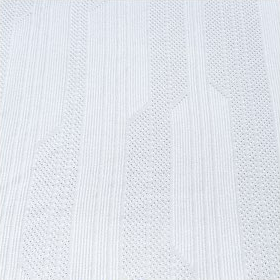
The new collection leads our material library with thirteen core, nine additional and eight patterned references. The fabrics are laboratory verified, and weights are expressed consistently in g/m². Explore a continuous-looking double-face body, a pin-eye surface, a stretch-knit option or a jacquard motif. The collection groups organise visual and material choices; the intended garment gives each selection its purpose.
B09 at 140 g/m² and C03 at 180 g/m² introduce two double-face directions. B07 at 120 g/m² adds a small-grid texture, while A01 at 190 g/m² introduces a geometric jacquard with elastane. The original fabric-detail library follows the new collection and remains available on enquiry. Request the exact specifications and sample options for an original reference that suits your design; a real detail image can be a productive starting point without a long technical table.
Repeated names remain separate records: B09 and C03 are both called double-sided fabric, yet show different nominal weights. Source names such as “milk silk” are trade names, not proof of milk-protein fibre. Website references identify the particular catalogue entry; they do not claim that two similar-looking swatches are the same material. This is why a useful shortlist carries reference IDs and source values together.
| Fabric reference | Composition | Weight | Garment focus |
|---|---|---|---|
| KITOEM-FAB-B09 | 100% polyester | 140 g/m² | Clean body surface and graphics |
| KITOEM-FAB-C03 | 100% polyester | 180 g/m² | Drape and garment coverage |
| KITOEM-FAB-C04 | 95% polyester / 5% elastane | 160 g/m² | Movement, fit and printed identity |
| KITOEM-FAB-A03 | 90% polyester / 10% elastane | 170–180 g/m² | Patterned panels and alignment |
Use a procurement matrix instead of a universal “best fabric”
The matrix below is a review plan, not a scorecard. Each row defines an observation that can change the selection. Agree which requirements are essential and which are preferences before comparing the samples. A decisive problem with coverage or fit cannot be cancelled out by an attractive texture or a lower price.
| Decision | Brief to provide | Compare on the sample |
|---|---|---|
| Climate and intensity | Venue, expected conditions, active duration and rest periods | Wearer feedback; relevant air and moisture evidence if those properties are claimed |
| Movement | Sprinting, reaching, bending or repeated flexing | Restriction, seam pull and fabric distortion in the intended directions |
| Fit | Loose, regular or close fit; actual size range | Drape, ease and return after movement; do not infer recovery from elastane percentage |
| White coverage | White/light panels, underwear and final fit | Consistent lighting and backing; dry, stretched and wet observations agreed in advance |
| Graphics | Fine text, large numbers, all-over colour or crest method | Legibility, edges, colour and surface behaviour on the actual fabric |
| Wear cycle | One event, a season or recurring member use | Inspection and care plan suited to the intended life, not a lifetime claim |
| Laundry | Care route, washing frequency and decoration constraints | Dimensions, shape, shade and artwork after the agreed care conditions |
| Budget and repeat supply | Separate development, garment and reorder needs | Comparable quote scope, sample records, material identity and substitution approval |
Football: compare artwork, coverage and freedom of movement
For a football match shirt, start with the approved cut and artwork. Small sponsor lettering, broad white areas and a textured dark panel create different sample questions. Ask whether the crest and numbers will be printed, transferred or otherwise applied, then review that method on the actual proposed surface. A plain swatch does not approve the finished graphic.
Place B09 (100% polyester, 140 g/m²) beside C04 (95% polyester / 5% elastane, 160 g/m²) to compare a polyester-only body with a blend direction. Keep the finished shirt size and artwork consistent. Watch how the panels fall, how the shoulder moves and how small crest details sit on the surface. A04 (100% polyester, 165 g/m²) introduces a houndstooth jacquard for a design that lets the textile pattern carry part of the team identity.
On the KR-MT-001 football match shirt route, keep the fabric discussion attached to the shirt only. Match shorts need their own movement and construction review; socks have a different material and knitting specification. A coordinated visual identity does not justify copying the shirt’s selected fabric across the full kit.
Basketball: check openings, surface and the intended silhouette
A sleeveless basketball jersey makes armhole position, reach and drape prominent buying decisions. Check the garment with the intended underlayer and have wearers reach, turn and bend. Evaluate the bound openings as well as the main body: a suitable swatch cannot correct an unsuitable armhole or binding construction.
B06 (100% polyester, 140 g/m²) and C05 (100% polyester, 180 g/m²) provide two pin-eye mesh directions. Look at the opening rhythm, the drape from the shoulder and the appearance of broad front lettering. A large wordmark deserves a full-size application view: the negative space in the textile becomes part of the graphic background. C03 (100% polyester, 180 g/m²) supplies a separate double-face option for a quieter body surface.
Use the existing KR-MT-002 jersey route and keep basketball shorts as a separate line. Do not promise reversibility, dark-to-light colourfastness or a particular snag rating unless those requirements are specified and supported. Source trade names containing a sports organisation are retained internally as search aliases, not published as authorised partnerships.
Running and team events: separate athlete garments from staff issue
Running buyers often want low bulk, a comfortable contact surface and a clear event identity. Compare B07 (100% polyester, 120 g/m²) with B04 (100% polyester, 140 g/m²) in the intended singlet or shirt. C08 (90% polyester / 10% elastane, 165 g/m²) adds a stretch-mesh direction for a closer-fit brief. Keep the planned graphic area in view: the race number, chest identity and sponsor treatment are part of the finished garment, not separate from the fabric decision.
An illustrative event programme might use a light textured shirt for participants, a more continuous graphic field for staff and a separate warm-up layer for early starts. The programme can look coordinated through colour, typography and artwork placement while using different fabrics. This is a planning example, not a claim about a completed customer order. It explains why a coherent visual identity does not require one material everywhere.
Separate runners, marshals, staff and finish-line participants in the brief. An active race garment, standing staff shirt and souvenir piece can need different cuts, care plans and cost priorities. Define the intended wearing period and whether the garment must perform after the event. Do not impose a technical finish on every user group simply because the order belongs to a sporting occasion.
Make the comparison repeatable and keep measurements separate
Request two or three identified swatches. Record face and back, composition, weight in g/m², colour and finish. Keep the swatch with its ID throughout discussion and sampling. Compare appearance under the same lighting, then review the intended colour in the garment. A clear sample record lets design, pattern and procurement teams discuss the same material without losing context.
The public ASTM catalogue distinguishes mass per unit area (D3776/D3776M) from air permeability (D737). AATCC TM195 addresses liquid moisture management, while its standards directory lists separate drying and laundering methods. Those distinctions support specifying the property you need; they do not provide results for this fabric library. Agree the current method edition, specimen condition and acceptance requirement with the testing provider before commissioning work.
For fit, review both fabric direction and the finished construction. Use the same comparison garment where practical and record movement, shape change and return after rest. For light colours, agree the backing, illumination and intended stretch or wet condition. A buyer observation is useful for approval but must not be relabelled as a standardised laboratory result.
Wash the decorated sample according to the agreed care plan, then compare it with the retained reference. Record which changes are acceptable: measurements, twisting, appearance, shade and graphic integrity. Do not invent a universal wash-cycle count. Where a measurable property is contractual, define the method and pass criterion instead of relying on a subjective phrase such as “premium quality”.
Protect the decision through quotation and reorders
Ask for quotations against the same garment, material candidate, decoration, quantity split, packing and destination. A fabric change can alter more than the material line: sampling, pattern adjustments and decoration trials may need reopening. A cheaper unit price is not comparable if it removes the agreed approval work or substitutes an unidentified material.
Keep the accepted swatch, finished sample, colour reference, artwork revision, measurement record and relevant reports linked to the product line. State that a replacement fabric needs approval even when its declared fibre content and weight resemble the original. Matching those two fields does not establish identical appearance, fit or care behaviour.
For future top-ups, record the identity of the approved version rather than relying on a remembered trade name. Availability, minimums, timing and colour continuity are confirmed for the actual repeat order. Retained references help evaluate a proposed replacement; they do not guarantee that the first material or dye lot will remain available indefinitely.
Selection scenario: one identity, different wearing jobs
Imagine a club programme containing a match shirt, basketball jersey and half-zip training top. Give the crest and typography a shared visual language, then choose a separate material route for each garment. A smooth field can foreground football identity, a pin-eye surface can supply a contrasting basketball texture, and a stretch-knit direction can support the closer silhouette of a training top. These are illustrative design roles, not a report of a completed KITOEM customer programme.
Use each product detail page to define its quantity and garment requirements, then attach the relevant fabric reference. The multi-product project brief keeps those choices together without merging their specifications. It becomes possible to discuss one coherent programme while still reviewing the different pattern, graphic and material questions that belong to each item.
Take a clear shortlist into the product brief
A good selection ends with a clear product, a short candidate list and a small number of decisive checks. Start in the fabric workbench, compare the exact references and carry them into an editable enquiry with the sport, garment, artwork and intended use. Request swatches or discuss fabric selection; a request is not a promise of free samples, stock or a delivery date.
Our laboratory-verified new collection gives the conversation composition, weight in g/m² and a range of distinct surfaces. The available original fabric details add further directions on enquiry. Use the professional method references to understand the properties relevant to your brief, then connect the selected fabric to the product. A coherent decision joins material, cut, identity and care instead of asking one fabric number to explain the whole garment.
Connect the original fabric detail to the sample brief
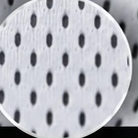
Our original Athletic Hole Mesh provides another available basketball direction. Compare the visible opening rhythm with the new pin-eye collection, and bring the planned jersey silhouette and lettering into the discussion. Exact specifications and sample options are available on enquiry.
What to confirm for your project
- Garment and wearer groups, kept as separate product lines
- Climate, movement, fit and duration of use
- Two or three fabric reference IDs
- Composition and weight in g/m²
- Colour coverage and actual artwork
- Care plan and relevant laboratory information
- Retained samples and reorder needs
- Project quantity, colours and sample scope
Questions to carry into supplier review
- What should we check after washing the sample before approving a bulk order?
- Should a brand choose a mechanically stretchy knit or add elastane to a running top?
- What product and batch records should our brand retain from the first production run for future reorders?
Questions buyers ask next
What fabric should our running club choose for shirts used in hot, humid weather?
Shortlist identified candidates for the intended cut, then compare coverage, movement and wearer feedback. Request relevant air and moisture evidence if those properties are required. Neither low nominal weight nor visible holes prove hot-weather performance.
Can a white custom running shirt stay reasonably opaque when stretched and wet?
It needs a garment-specific review. Agree the illumination, backing, stretch and wet conditions and assess the actual white fabric in the intended fit. No coverage result is inferred from the supplied weight labels.
Can we compare fabric swatches with finished samples before choosing the club's shirt material?
Yes—use swatches to narrow the materials, then use the finished garment to evaluate cut, seams, graphics and movement. Keep the same reference IDs on both and state what each approval resolves.
Should staff volunteers wear technical fabric if they will mostly stand at event checkpoints?
Define their weather exposure, shift duration, fit and care needs separately from the athletes. A technical finish is a requirement to justify and verify, not an automatic feature of every event shirt.
How do we approve a fabric substitution if the original material becomes unavailable before production?
Identify the replacement and compare it with the retained reference, approved garment, artwork and relevant evidence. Record the differences and obtain written approval before production; matching composition and nominal weight alone is insufficient.
Technical references and question evidence
- Laboratory verification and g/m² confirmed by KITOEM on 2026-10-12; request reference-specific information in the project enquiryKITOEM new fabric collection—thirty laboratory-verified references
- Public method identity; full procedures not reviewed or reproducedASTM public textile standards catalogue—D3776/D3776M-20(2025) and D737-18(2023)
- Public purpose and scope onlyAATCC TM195—Liquid Moisture Management Properties of Textile Fabrics
- Public method directory; no KITOEM test resultAATCC standard test methods and procedures directory
Technical references support the discussion method. Question evidence documents public discussion of an issue; it does not diagnose a KITOEM product or establish a test result.