
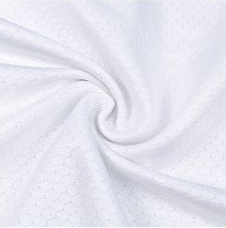
The decision in one paragraph
Choose between polyester and polyester–elastane by the required fit, movement and approval evidence—not by treating elastane percentage as a recovery score. A knit can stretch through its construction; an elastane blend still needs directional stretch, recovery, print and garment checks.
Fit is the specification; fibre content is one input
A teamwear brief can ask for freedom of movement, a clean fitted silhouette and artwork that stays readable. Those requirements do not translate automatically into a particular elastane percentage. A loose football shirt, a closer training top and a garment with loaded pockets create different demands. Begin with the actual cut and movements, rather than adding elastane because it sounds like a premium feature.
Our new fabric collection is laboratory verified. This guide explains how to translate material selection into a wearable garment: extension describes movement under load; recovery describes the return after that load is removed. Seams, hems and decoration then shape how that response feels on the body. Start with the motion the garment must support and select the fibre mix, structure and pattern together.
Read the available blend records precisely
The core collection includes 100% polyester options. C04 combines 95% polyester and 5% elastane at 160 g/m²; C08 combines 90% polyester and 10% elastane at 165 g/m². A01 offers a 92/8 blend in a geometric jacquard at 190 g/m², while A02 uses a 91/9 blend at 160 g/m². These are different design directions: compare the surface, the garment ease and the graphics before choosing a blend simply because it contains more elastane.
Do not repair incomplete information to make the comparison look tidy. C09 has an impossible source composition total and remains pending; C07 has no composition entry. C02 carries a commercial name sometimes translated as milk silk, but its stated composition is polyester–elastane, not milk-protein fibre. The source groups advanced and upgraded do not prove that one blend gives a better wearer outcome than the basic group.
| Reference | Composition | Selection focus | Garment review |
|---|---|---|---|
| B09 | 100% polyester | Can this structure suit the intended ease? | Directional extension and recovery |
| C04 | 95% polyester / 5% elastane | How does the printed sample move? | Actual movement and process compatibility |
| C08 | 90% polyester / 10% elastane | Does the mesh retain coverage at fit extension? | Coverage, recovery and claim-specific tests |
| A01 / A02 | 92/8 and 91/9 polyester–elastane | Does the textured surface suit the design? | Finished garment behaviour |
Separate construction stretch, extension and recovery
A knitted structure can change shape as its loops move. Fibre content is therefore not a complete description of how easily a fabric extends in a particular direction. For procurement, ask for the direction of useful movement, the effort needed to obtain it, and the amount of residual change after use. Treat these as separate observations rather than replacing them with a single word such as stretch.
The garment pattern matters because it determines how much extension occurs in wear. A fabric accepted in a loose fit can behave differently in a close fit, particularly at shoulders, hips and knees. Seams and decoration can restrict a flexible panel. Conversely, extra ease can reduce the need for extension without changing the fabric. Review the fabric and pattern as a system before asking for a higher elastane content.
Compare candidates with a defined movement brief
Select a current reference and a blend alternative that addresses a named need. State the target silhouette, wearer range and relevant movements: arms raised, a running stride, a basketball shooting motion or seated travel. Ask the sample maker to identify fabric direction in the garment. Keep size and pattern differences visible so a better-fitting sample is not incorrectly credited to the composition alone.
An informal hand stretch is useful for initial discussion, but it is not a reproducible recovery report. If recovery is a contractual requirement, agree a suitable laboratory method, specimen conditioning, loading direction, extension or force, cycles and recovery period with the lab. The buyer should set commercially meaningful acceptance criteria with technical advice. This article does not invent a universal pass mark or reproduce a standard procedure.
- Record the sample reference and direction
- Define the movement and desired ease
- Review seam, hem and print restriction
- Separate first wear from repeated wear and wash
- Agree the evidence and criteria before bulk release
Approve the real artwork on the real blend
Do not transfer an approval from a polyester garment to a polyester–elastane candidate merely because both are mostly polyester. Use the proposed decoration process, actual colour and final-size graphic on the chosen reference. Inspect fine text, crest edges and large solid areas in the relaxed garment and during the agreed movements. Where appropriate, include a wash review and document how the print looks afterwards.
The supplier must confirm compatible processing conditions for the fabric and decoration combination. A process selected for one reference is not a blanket permission for the whole material library. Buyers should state whether white coverage, shade change, print cracking, distortion or hand feel would make the sample unacceptable. Those are approval questions, not inevitable effects asserted for every elastane blend.
Selection scenario: a fitted training top
For an illustrative fitted training top, place B13, a 100% polyester fine double-face knit at 140 g/m², beside C02, a 90/10 polyester–elastane option at 190 g/m². Keep the sleeve length, shoulder shape and intended size consistent. Ask the wearer to reach overhead, bend forward and settle into a neutral posture. Observe where the cloth forms folds, where a seam pulls and whether the hem returns comfortably after movement.
A flexible body also needs a compatible graphic treatment. Position the proposed logo at its final size and review it during the same motions, rather than stretching an undecorated scrap in isolation. This example is a development scenario, not a reported customer trial. It shows how fabric, pattern and identity work together: the most useful option supports the intended silhouette and motion as a complete garment.
Control care, fit changes and future substitutions
A sample review should cover the intended care routine rather than a random wash. Keep detergent, temperature, drying and the number of review cycles in the record when those details influence the decision. Measure the same garment points before and after the agreed review. Note persistent bagging or a change in shape separately from dimensional change; neither should disappear into the general comment that the shirt still feels soft.
If the material changes after a pattern is approved, issue a revised technical pack. Identify whether the fit, seam construction, artwork or grading needs review. Preserve the previous approved version so the supplier can explain what changed. A repeat order with the same fibre percentages is not necessarily the same reference, finish or lot, and should not bypass the substitution approval route.
Research supports test planning, not a blend league table
Teyeme and colleagues compared four polyamide–elastane cycling fabrics using separate comfort-related measurements. Those fabrics differ substantially from these polyester-based options, including their elastane ranges and knit structures. Their results cannot rank C04 against C08 or establish a KITOEM drying time. The transferable principle is to evaluate relevant properties separately and identify the tested material.
Matusiak and Sukhbat investigated cotton-based knit fabrics in relaxed and stretched states, finding changes in liquid transport under their study conditions. That does not establish a polyester result or a recovery grade. It does justify asking whether testing and garment review represent the intended fit state. The present guide remains a technical buying analysis, not a KITOEM experiment, a compression certification or a medical recommendation.
Choose the smallest justified change
If the current polyester reference meets the movement, appearance and care requirements, there is no reason to replace it solely to obtain a higher blend percentage. If closer fit or repeated movement exposes a problem, compare an appropriate blend and, where useful, a different knit or pattern. Approve the solution that resolves the problem while preserving the required print, colour and commercial scope.
Bring the intended garment, fit reference, artwork and two candidate material IDs to the enquiry. Keep commercial quantities and material requests separate so the supplier can discuss availability, sampling and cost without silently rewriting the product BOM. Once approved, record both the physical sample and its specification. That is a more dependable reorder instruction than asking for the same stretchy feel.
Connect the original fabric detail to the sample brief
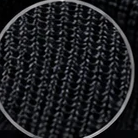
Explore our available Four-Way Stretch Knit for movement-focused training garments. The real detail photograph helps compare the surface with a stretch-knit option from the new collection. Ask us for the exact composition, weight and sample configuration for your fit brief.
What to confirm for your project
- Fit and movement brief
- Identified composition and construction
- Stretch directions and recovery evidence required
- Print and seam combination
- Care review and substitution approval
Questions to carry into supplier review
- Is the problem in the fabric, the pattern or both?
- Does the test reflect the intended fit?
- Which change requires a new sample?
Questions buyers ask next
Should a brand choose a mechanically stretchy knit or add elastane to a running top?
Compare the intended fit and movements on identified candidates. Construction stretch and an elastane blend are different development routes, neither a universal winner.
Will a polyester-elastane running shirt work with our all-over printed design?
Confirm the selected fabric and process, then approve actual artwork on a garment sample. The blend percentage does not approve the print combination.
What should a revised tech pack show when we change the fabric but want to preserve the approved fit?
Record the new reference and specification, affected pattern and seam decisions, sample revision and required reapproval. Keep the previous approved version.
How should we assess knee and elbow fabric recovery after repeated flexing in a tracksuit?
Define representative movements and review conditions, then use appropriate agreed recovery evidence. Do not substitute elastane percentage for a recovery result.
Technical references and question evidence
- Original research; polyamide–elastane samples, not these polyester fabricsTeyeme et al. (2020) — Comparative Analysis of Thermophysiological Comfort-Related Properties of Elastic Knitted Fabrics for Cycling Sportswear
- Original research; cotton-based samples, not KITOEM test resultsMatusiak and Sukhbat (2023) — Influence of Stretching on Liquid Transport in Knitted Fabrics
Technical references support the discussion method. Question evidence documents public discussion of an issue; it does not diagnose a KITOEM product or establish a test result.