
The decision in one paragraph
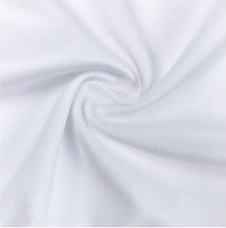
Fabric weight is mass per unit area, expressed in g/m². Use it alongside structure, thickness, colour and garment fit. KITOEM’s new fabric collection is laboratory verified; the final garment brings that material together with your cut, colour and artwork.
The procurement question and the analytical boundary
A buyer often asks for a lighter shirt after a hot tournament, or a heavier one after a complaint about coverage. Neither instruction fully describes the problem. The wearer may have experienced a close fit, a large chest transfer, a base layer or a different wash history. A change in nominal weight can accompany those differences without being their cause. This analysis separates the measurement of mass from the commercial decisions it is often asked to settle.
The objective is a short, defensible shortlist. It is not to identify a universally best GSM for football, basketball or running. Start with the intended wearer, activity, climate, colour, garment cut, print area and care routine. Explain which problem needs improvement and which approved features must remain. That framing lets the buyer compare two or three useful samples instead of requesting the lightest fabric in a catalogue.
Read the new collection in g/m²
The KITOEM new collection is laboratory verified, and its fabric weights are expressed in g/m². B09 is a 140 g/m² double-face reference; C03 is a separate 180 g/m² double-face reference. The difference is forty grams per square metre of fabric, not forty grams per finished shirt. Garment size, panel area, trims and decoration all contribute to the finished garment mass. Keep the material reference alongside the number so that a reorder identifies the fabric, rather than only a weight class.
A03 supplies a striped jacquard mesh at 170–180 g/m². Its pattern can introduce direction across a panel, making repeat and cutting orientation useful design questions. A08 supplies an engineered diamond-stripe appearance, with its exact weight available on enquiry. Explore these textures as different creative choices. For A03, discuss usable cutting width separately from weight so the pattern maker can plan panel placement on the actual fabric.
| Reference | Source weight | What can be used now | Outstanding point |
|---|---|---|---|
| B09 / C03 | 140 / 180 g/m² | Two double-face options | Choose garment drape and coverage |
| A03 | 170–180 g/m² | Striped jacquard mesh | Panel alignment and usable width |
| A08 | Available on enquiry | Engineered diamond-stripe direction | Request exact fabric specification |
What mass per area describes—and what it leaves out
ASTM D3776/D3776M-20(2025) addresses fabric mass per area. Its public scope distinguishes sampling options, and explains that a small-swatch result represents that sample rather than necessarily its lot. This is a useful boundary when a buyer receives a neatly cut square and assumes it proves the entire bulk order. The guide does not reproduce the paid method or prescribe an unverified laboratory procedure.
For selection, treat mass as one coordinate alongside the actual structure. Ask whether two references have comparable yarn, openings, thickness, finish and intended fit. If several variables change together, an improved sample does not isolate the effect of weight. A buyer can still choose the sample, but should approve its complete specification rather than write a general rule that every lighter or heavier alternative is better.
Coverage is a garment decision, not a number on a swatch
White and pale garments deserve their own approval task. Review the intended colour under consistent front and back lighting, over the actual base layer if one is expected. Compare a relaxed panel with the degree of extension created by the garment fit. Inspect the chest, shoulders and seams in representative movements. A dark flat sample cannot settle whether a white fitted shirt will provide acceptable coverage.
Where wet appearance matters, agree a repeatable sample review with the supplier and keep it distinct from a formal opacity test. Record the conditions, the observer and the approval photographs. Decide what unacceptable show-through means for the programme before looking at samples. Approval should name the colour and garment version; it should not become an unqualified claim that the fabric is opaque in every colour, light condition and fit.
Build a comparison that can answer the actual complaint
Choose a current approved fabric as the control, then shortlist alternatives with a clear reason for inclusion. If the issue is white coverage, include candidates that offer different surface or density directions and make them in the intended cut. If the issue is perceived heat, identify whether the requirement concerns air movement, liquid sweat transfer, drying or insulation before selecting a test. These are different questions and may lead to different winners.
Keep supplier submissions comparable: fabric reference, lot where available, colour, finishing state, test method and edition, specimen condition and reported units. Request full reports rather than screenshots containing only a grade. If a mass tolerance becomes part of the order, agree the tolerance, sampling basis and corrective route in writing. Do not invent a tolerance by copying one from an unrelated garment or treating the nominal catalogue figure as a guaranteed minimum.
Compare commercial consequences in a separate column. Ask how each candidate changes the quotation, material commitment, cutting plan and sample work. Keep the garment quantity constant when requesting alternatives, and ask the supplier to identify which assumptions differ. A seemingly inexpensive fabric may require a different artwork trial or pattern adjustment; that is a quotation question, not a reason to declare it inferior. Likewise, do not infer usable width or yield from a weight entry. The buyer needs the complete cost and approval scope of each candidate, not a price-per-weight shortcut.
| Decision | Evidence to compare | Do not substitute |
|---|---|---|
| Weight control | Identified sample, method and units | A hand-feel impression |
| Air movement | Comparable air-permeability evidence | Lower catalogue weight |
| White coverage | Intended garment, colour and movement review | A black flat swatch |
| Durability | Relevant use and agreed test evidence | Higher catalogue weight |
Use literature to design a question, not to borrow a result
Salopek Čubrić and colleagues studied several single and double knit structures using cotton, wool, acrylic and polyamide yarns on a 12-gauge machine. The work considered multiple structural variables alongside thermal and air measurements. Those specimens are not this polyester catalogue. Its value here is the analytical model: collect more than one structural variable, and keep measurement conditions visible. No published numerical result is assigned to a KITOEM reference.
Think of a fabric specification as a map with several coordinates. Mass locates the weight direction; structure describes the surface and openings; thickness and finishing help describe the handle. A shirt takes shape when those coordinates meet the pattern. This is why a clean double-face body, a visible mesh panel and a jacquard identity can all be sensible choices inside the same teamwear programme. The choice becomes stronger when the designer can explain the role of each material.
Selection scenario: a white football shirt with a large crest
Consider an illustrative brief for a white football shirt with a dark crest and broad back number. Begin with B09 at 140 g/m² and C03 at 180 g/m², keeping the shirt pattern and graphics identical. Look at the chest in ordinary light, the fabric over the intended underlayer and the way the hem falls after movement. The comparison gives the buyer a concrete choice between two garment expressions, rather than a debate about whether heavier always means better.
The crest is a second part of the same decision. Compare the smallest lettering and solid colour edges on each decorated sample. Review shoulder reach and the back number while the garment is worn. This is an illustrative selection exercise, not a reported customer order: the outcome is the fabric-and-artwork combination that serves the intended silhouette, colour coverage and identity.
Release a complete fabric decision, not a GSM slogan
Once the samples are reviewed, record the fabric identity, composition, weight in g/m², colour, finish, pattern and decoration together. Keep the chosen physical sample with the final specification and the artwork version. This connects the wearing decision to the production handover and makes the record useful for reorders. A specific material-and-garment choice gives the next buyer considerably more guidance than a weight number alone.
For a first enquiry, bring the intended garment and two or three material references. Tell us which details deserve priority: lightness, a clean graphic field, a softer drape or a particular textured appearance. We can discuss the exact material and sample route in the editable project brief. Our original fabric range is also available for enquiry, giving the designer more texture directions without overloading the first conversation with technical paperwork.
Connect the original fabric detail to the sample brief
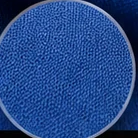
Interlock Knit is also available in our original fabric range. Its real surface detail introduces a useful conversation about a smooth jersey body, coverage and graphic clarity. Send the reference with your intended garment to receive the exact specifications and sample options.
What to confirm for your project
- Selected fabric and weight in g/m²
- Intended colour, fit and base layer
- Printing and finishing state
- Relevant laboratory information
- Approved specification and substitution rule
Questions to carry into supplier review
- Which complaint must the replacement solve?
- Which approved garment details must not change?
- Does the sample represent the proposed bulk fabric?
Questions buyers ask next
Does a higher GSM make a custom running shirt more durable or just heavier?
A higher g/m² value means greater fabric mass per area. Evaluate durability through the relevant wear mechanism, construction and laboratory information; then compare the garment’s drape, movement and care behaviour.
Can a white custom running shirt stay reasonably opaque when stretched and wet?
Make that a colour- and fit-specific approval requirement. Review the intended sample in agreed conditions; do not promise the result from weight alone.
Why can two suppliers quote different prices for jerseys made from the same stated fabric weight?
Equal stated weight does not define yarn, construction, finish, cutting, decoration or approval scope. Compare the full specification and quotation assumptions.
How can a buyer compare warmth without treating fabric GSM as a temperature rating?
Specify the layering and conditions, then compare suitable samples and relevant thermal evidence. Do not convert GSM into an outdoor temperature promise.
Technical references and question evidence
- Official method scope; full procedure not reviewedASTM D3776/D3776M-20(2025) — Mass Per Unit Area (Weight) of Fabric: public scope
- Original research; different materials and knitting conditionsSalopek Čubrić et al. (2022) — Material and Structural Functionalization of Knitted Fabrics for Sportswear
- Official method listing; full procedure not reviewedASTM D737-18(2023) — Air Permeability of Textile Fabrics: official listing
Technical references support the discussion method. Question evidence documents public discussion of an issue; it does not diagnose a KITOEM product or establish a test result.