
The decision in one paragraph
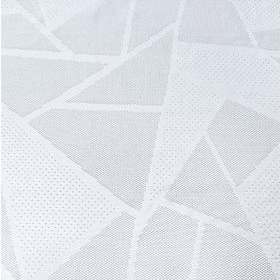
Mesh offers a visible opening rhythm, interlock provides a double-knit structure, and jacquard adds an engineered pattern to the textile surface. Choose them by their role in the garment: the graphic field, body-facing surface, panel shape and visual identity. Our laboratory-verified new collection connects these conversations with composition and weight in g/m².
A structure comparison starts by identifying the specimen
Buyers use the word mesh for many different surfaces, from obvious holes to a fine pinhole appearance. They may also describe any smooth double-face fabric as interlock. Jacquard describes a patterning direction, while the actual fabric can still differ in yarn, density and construction. These words help a conversation, but they do not create three mutually exclusive performance grades.
This analysis treats structure as a development input: what does the chosen surface allow the garment to look like, how does it interact with fit and artwork, and what evidence is needed before release? The goal is not to make every shirt technically elaborate. A simple surface can be the right choice for a complex graphic, while a textured candidate may earn its place in a quieter design. Both require a specific approved reference.
Preserve independent references and avoid false translations
The source-backed workspace includes small and larger mesh directions, pinhole and double-face names, and several jacquard appearances. KITOEM-FAB-B09 and C03 remain separate double-face references. Neither should be relabelled as technically verified interlock without a sample or construction record. A website translation should explain the visible or named direction without converting a commercial name into a knitting certificate.
KITOEM-FAB-A01 is a geometric jacquard reference with a stated 92% polyester and 8% elastane blend; A04 is a houndstooth jacquard reference listed as 100% polyester. A03 is a jacquard stripe-mesh direction. These descriptions support a shortlist of different appearances, not claims about superior cooling. Source aliases containing third-party names are retained internally for traceability, while the public reference uses neutral wording and the KITOEM discussion ID.
| Direction | What the source can support | What requires confirmation |
|---|---|---|
| Mesh / pinhole | Named or visible openings and texture | Hole scale, precise construction and airflow |
| Double-face | An independent source reference and nominal specification | Whether technically interlock; yarn and knit details |
| Jacquard | Named pattern direction and source composition | Exact construction, repeat, placement and performance |
Match the surface to the identity system
Before choosing a swatch, collect the smallest text, crest detail, large colour block and any sponsor mark that must appear on the garment. A fabric review made only with a large uncomplicated logo leaves the hardest print decision unanswered. Ask the decorator to test the proposed method at final size on the actual candidate. Inspect the result at wearing distance and close enough to judge edge and line continuity.
On a visibly open surface, examine whether the garment identity remains readable across the openings and whether placement interacts with seams or panel edges. On a patterned surface, check the relationship between the fabric pattern and the graphic. A sample may be aesthetically unsuitable even if the application is technically possible. Record the rejected combination rather than declaring the whole structure unprintable.
Observe both sides and the fabric in movement
A face photograph is not enough to approve a fabric. Compare the reverse surface, the feel against the body and the appearance in the actual colour. View the panel relaxed and extended to the fit state it will experience in the garment. Confirm which face is intended outside and how cutting direction affects the appearance. A repeat that looks balanced on a small square can become visually uneven across a full shirt.
For jacquard directions, review a large enough sample to understand repeat and placement. Do not promise exact positional alignment from a tiny photograph. Where a buyer needs a controlled pattern position, identify the pattern repeat, cutting requirements and affected sizes before quoting that work. A03 also needs its mixed width-and-weight source field clarified; the width fragment should not be treated as usable cutting width without confirmation.
Build a panel decision rather than forcing one fabric everywhere
A buyer may consider a more continuous front surface for detailed identity and a mesh direction elsewhere. Treat that as a garment-development proposal, not a ready-made construction promise. Review the visual relationship, seam compatibility, movement and care of the combined sample. Keep each fabric reference in the BOM so a later substitution cannot change one panel unnoticed.
Do not apply the entire jersey library to socks, bags or weather outerwear. Those products have different construction and functional requirements. Likewise, a candidate discussed for a basketball top is not automatically the approved material for every item in a team pack. Use the existing product record as the stable starting point and add the selected references as options for review, not as an overwrite of its standard specification.
Measure a requirement instead of trusting the structure label
Salopek Čubrić and colleagues compared specific single and double structures and showed why material and geometry must be considered together. Their tested yarns and machine conditions differ from this catalogue. Their air-measurement conditions also differed for some sample groups, which limits direct cross-group comparison. The lesson for a buyer is to inspect the method details before merging values into one ranking, not to borrow their result for mesh or interlock here.
If airflow is commercially important, request comparable air-permeability evidence. If snagging is the concern, agree the relevant use exposure and test with technical advice. If the issue is print detail, approve the physical application. One report cannot answer all three questions. Keep the order of decisions practical: reject visibly unsuitable combinations first, then invest in tests that can settle the remaining risk.
Create a sample matrix with one identifiable variable per choice
A useful matrix holds the garment and artwork constant while comparing a mesh, a double-face reference and a jacquard direction. Record the composition, weight in g/m² and surface for each candidate. If the pattern or graphic application changes, identify that revision as a separate design variable. The buyer can then understand whether the preferred result comes from the material surface, the garment fit or the identity treatment.
For each submitted sample, keep the material ID, source alias, colour, finish, sample date, artwork version and sample maker record. Separate initial appearance from results after the agreed care review. Record decisions as approved, approved with conditions or revise, with open points attached. A generic statement that the mesh is premium is not an acceptance criterion and gives little help when the programme is reordered.
Selection scenario: let the pattern and crest share the stage
Imagine a football shirt with a geometric fabric motif and a detailed club crest. A01 supplies a geometric jacquard direction at 190 g/m²; B09 supplies a quieter double-face direction at 140 g/m². Make the same crest visible on both. On the patterned option, consider whether the repeating geometry competes with small lettering. On the quieter option, consider whether a controlled contrast panel could supply the visual energy instead.
This illustrative exercise separates two valid creative routes. One builds identity into the fabric surface; the other gives the artwork a simpler background. Review the panel join, pattern alignment and reverse-side contact as well as the front photograph. Link the preferred fabric to the football shirt detail page and carry its reference into the project brief, so the next discussion starts with a specific garment rather than an isolated texture.
Choose a structure for a job, not for a catalogue tier
Our new collection is laboratory verified, and the collection groups make the range easy to explore by surface direction. A quiet double-face body can give a bold crest room to breathe visually; a jacquard can carry identity through the cloth itself; a mesh can introduce a contrasting panel rhythm. Treat the graphic and fabric as two parts of one composition. The best design often has a clear hierarchy, rather than the greatest number of technical features.
Bring the intended product, actual identity files and candidate material references to the next enquiry. Ask for the smallest sample exercise that can resolve the important differences. This produces a reasoned material decision and a traceable handover to production, while leaving commercial availability, process conditions and acceptance limits to the actual project review.
Connect the original fabric detail to the sample brief
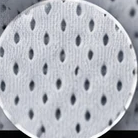
Bird Eye Mesh brings a regular, distinctive texture to the original fabric range. Look at how the surface repeats across a panel, then consider the balance between a quiet base and a prominent crest. Enquire with this reference for detailed specifications and product development.
What to confirm for your project
- Independent fabric and sample IDs
- Face, reverse and cutting direction
- Actual artwork at final size
- Pattern repeat and placement needs
- Product-specific sample and test plan
Questions to carry into supplier review
- Does the fabric pattern compete with the artwork?
- Would different panels solve different jobs?
- Which construction detail is still only a catalogue name?
Questions buyers ask next
What should we compare in mesh and smooth-knit fabrics for club running shirts?
Compare both surfaces, fit-state coverage, actual graphics, hand feel and the claim-specific evidence. Keep composition, finish and sample identity visible.
What mesh hole size should we examine before printing small graphics on basketball jerseys?
Examine the actual candidate at final graphic size; no universal hole-size limit is established here. Approve readability and application on the selected sample.
Can we request yarn and knit details when a supplier describes a fabric only as premium sports polyester?
Yes. Ask for identifiable construction information and the physical reference. Premium is not a complete fabric specification.
What material information should be recorded when several mills use the same commercial fabric name?
Use separate source or sample IDs, composition, construction, nominal weight with units, colour and finish. Do not merge records by name alone.
Technical references and question evidence
- Original research; different materials and knitting conditionsSalopek Čubrić et al. (2022) — Material and Structural Functionalization of Knitted Fabrics for Sportswear
- Official method listing; full procedure not reviewedASTM D737-18(2023) — Air Permeability of Textile Fabrics: official listing
Technical references support the discussion method. Question evidence documents public discussion of an issue; it does not diagnose a KITOEM product or establish a test result.