
The decision in one paragraph
Wicking, drying, air permeability and water-vapour behaviour describe different processes. Select the claim first, then agree a matching method and comparable conditions. A moisture-management result is not an airflow result, and a fibre percentage or open-looking texture is not a test report.
Replace breathable with a question a test can answer
A buying brief may use breathable, quick-drying and moisture-wicking as though they were interchangeable. A lab cannot resolve that ambiguity by issuing one number. The programme first needs to state the wearer problem: liquid lingering next to the skin, a shirt remaining wet between games, insufficient air movement, or the behaviour of a layered outfit. Each problem points toward different evidence and potentially a different material decision.
KITOEM’s new fabric collection is laboratory verified. This guide explains how to read the different properties relevant to a sportswear brief. A fabric can move liquid, allow airflow and release moisture through distinct mechanisms. Understanding those mechanisms makes the conversation more useful: identify the wearer problem, review the relevant laboratory information, then connect the material to the intended garment and care routine.
Keep the four processes separate
Liquid transport concerns the movement of moisture on and through a fabric. Drying concerns the removal of moisture under defined conditions. Air permeability concerns air passing through a textile under a test setup. Water-vapour behaviour concerns moisture in gaseous form. A fabric can be evaluated in more than one way, but the existence of a result for one process does not make the others measured.
For the buying record, translate each marketing term into an intended use and a result that would support it. A warm-up layer worn over a jersey is a different system from the jersey alone. A large applied chest graphic is different from an undecorated swatch. Define which specimen represents the saleable item and which tests are only early-stage screens. This prevents a clean fabric report being treated as approval for every finished garment.
| Buyer question | Evidence category | Not an equivalent result |
|---|---|---|
| How does liquid move through the fabric? | Liquid moisture management / wicking | Air permeability |
| How does the sample lose moisture? | Drying under defined conditions | A spreading photograph |
| How does air pass through the textile? | Air permeability | Fibre composition or GSM |
| How does vapour behave through the system? | Water-vapour resistance / permeability | Liquid transfer or surface water repellency |
Read the public scope before requesting a method
AATCC TM195 evaluates liquid moisture management in fabrics. Its public summary identifies liquid behaviour associated with structure and wicking characteristics; it is not an air-permeability method. ASTM D737-18(2023) is the separately identified air-permeability method. Their full procedures are not reproduced or claimed to have been reviewed here. A competent laboratory should confirm the applicable edition, specimen and reporting conditions for the actual requirement.
AATCC TM214 addresses condensation on textiles in a humid microclimate, including defined dry and simulated-precipitation conditions. It is not a generic quick-drying test. Do not select it because a search result mentions wet and dry conditions. Where drying is the requirement, ask the laboratory to propose an appropriate drying method and explain what its endpoint means before the buyer sets an acceptance limit.
Start with the material, then read the relevant property
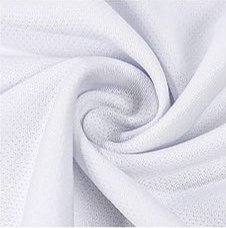
B06 is a 100% polyester pin-eye mesh at 140 g/m². C08 is a 90/10 polyester–elastane stretch mesh at 165 g/m². A03 offers a striped jacquard mesh at 170–180 g/m². These laboratory-verified fabric directions introduce three different surfaces into the garment conversation. Keep the exact reference beside the relevant report so the property discussed belongs to the selected material and finishing state.
For a basketball body, compare the opening pattern with the size of the front lettering. For a fitted training panel, compare the surface at the extension created by the pattern. For a running shirt, consider the large graphic area and contact points beneath a layer. The practical question is how the textile meets the wearing brief. Contact us for the exact laboratory information relevant to the shortlisted fabric, rather than trying to derive a drying result from its weight.
Make the report interpretable before comparing its headline
Request the full report with the sample identifier, composition, colour, finish, laboratory, method and edition, date, reported units and specimen conditions. For airflow comparisons, ask whether pressure difference and test area are comparable. For liquid behaviour, identify the fabric face and any stretch state. For drying, identify how moisture was introduced, the ambient conditions and the defined endpoint. Do not invent standard conditions when the report omits them.
Ask what the reported result represents: one specimen, repeated measurements, an average or a classification. Retain variation and qualifications rather than keeping only the best value. If two suppliers used different methods, there may be no valid direct ranking. A practical solution is to have the candidates evaluated under an agreed common method, or keep the evidence side by side with its limitations instead of manufacturing a conversion.
- Match the test specimen to the proposed fabric
- Identify method edition and relevant setup
- Keep units, variation and limitations
- Agree wash or ageing state if relevant
- Define acceptance and corrective actions before release
What original studies can—and cannot—teach the buyer
The cycling study by Teyeme and colleagues measured several comfort-related properties separately on polyamide–elastane fabrics. It used a very different material set from this catalogue. Its relevance is that liquid management, drying, air and vapour measurements were not collapsed into one result. We do not reuse its numerical values as polyester specifications or declare a KITOEM summer-cycling winner.
The stretching study by Matusiak and Sukhbat used cotton and cotton-blend T-shirt fabrics, with measurements in relaxed and stretched states. Results and variation depended on the specimen and setup. Atalie and colleagues studied combinations of inner and outer layers rather than these standalone references. Those studies support a cautious question about fit state and layering, not a guarantee that every stretchy mesh or polyester blend will manage sweat in the same way.
Carry the decision through printing, care and actual use
A lab result on an undecorated sample does not automatically describe a large transfer, lining, seams or a complete outfit. After screening candidates, review the intended garment with real artwork and relevant base layers. Identify whether the wearer problem persists in the proposed fit. Use the resulting observations to refine the development brief; do not present a small wearer review as a controlled clinical study.
Where a performance claim must survive care, agree the care state that the evidence should represent. Retain the specimen identity before and after treatment. A report on a new fabric and a comment that an unrelated shirt washed well do not make a durability claim. Consider the claims separately from colour, dimensions and decoration, because a garment can meet one approval condition while failing another.
Selection scenario: a shirt worn between two training sessions
In an illustrative two-session training brief, separate the active period from the interval. During movement, the wearer notices the cloth at the shoulders, chest and back. Between sessions, the practical question becomes how the damp garment feels and changes over time under the actual surroundings. This distinction gives the buyer two useful review tasks instead of one vague request for a breathable shirt.
Keep the garment fit and artwork consistent while comparing candidates, and record which sample face is next to the body. Read the relevant drying and liquid-management information separately, then review the finished garment after the intended care route. This is a selection scenario, not a KITOEM customer result or a numerical performance promise. It turns the test terminology into a conversation about how the garment will actually be used.
Connect the property, material and garment
A useful laboratory discussion connects three things: the property, the identified material and the intended garment. Liquid transport, drying, airflow and vapour behaviour each deserve their own line in the brief. Our collection’s laboratory verification provides the material starting point; the project discussion establishes which results matter for your garment, artwork and care conditions. Keep individual measurements with their methods and units, rather than combining them into an undefined comfort score.
A useful procurement conclusion names the use, candidate references, required claim, proposed test route and final sample approval. Attach the evidence to the agreed specification and make substitution review mandatory. In the enquiry, include destination conditions and care expectations where known, but leave missing details blank. That gives the supplier a clear discussion starting point without creating false test results, delivery promises or guarantees.
Connect the original fabric detail to the sample brief
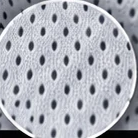
Pin Dot Mesh is an available direction for training development. Its fine surface is a useful starting point for a garment combining small identity details with repeated movement. We can discuss the exact fabric specification and the relevant laboratory information for your intended application.
What to confirm for your project
- Claim and intended use
- Fabric and decorated-garment specimen identity
- Method, edition, setup and units
- Care and fit state
- Acceptance limits and substitution review
Questions to carry into supplier review
- Which process is the buyer actually asking about?
- Does the report represent the garment being sold?
- What part of the claim still lacks evidence?
Questions buyers ask next
How should we compare fabric air permeability results when suppliers use different test methods?
First compare methods, editions, units and setup. If they are not comparable, request a common evaluation or retain the differences as a limitation; do not rank converted numbers without technical justification.
Can identical polyester percentages still produce noticeably different moisture management?
Composition is not a complete specification. Compare identified structures, finishes and relevant test evidence rather than assuming equal fibre percentages give equal performance.
What should a fitness brand check before advertising a fabric as breathable?
Define what the claim means for the intended garment, obtain matching evidence and confirm the wording does not imply unmeasured liquid, drying, airflow or vapour results.
What evidence should support a moisture-wicking claim on fitness shirts sold in the US?
Use a claim-specific report on an identifiable relevant specimen, with method, conditions and limitations. Confirm market-specific claim requirements with qualified advice; this guide is not a regulatory approval.
Technical references and question evidence
- Official method scope; full procedure not reviewedAATCC TM195 — Liquid Moisture Management Properties of Textile Fabrics: public scope
- Official method listing; full procedure not reviewedASTM D737-18(2023) — Air Permeability of Textile Fabrics: official listing
- Official technical explanationAATCC — Stay Up to Date with the Latest Textile Test Methods: TM214 condensation scope
- Original research; polyamide–elastane samples, not these polyester fabricsTeyeme et al. (2020) — Comparative Analysis of Thermophysiological Comfort-Related Properties of Elastic Knitted Fabrics for Cycling Sportswear
- Original research; cotton-based samples, not KITOEM test resultsMatusiak and Sukhbat (2023) — Influence of Stretching on Liquid Transport in Knitted Fabrics
- Original research; a different multilayer systemAtalie et al. (2021) — Thermo-Physiological Comfort Properties of Sportswear with Different Combination of Inner and Outer Layers
Technical references support the discussion method. Question evidence documents public discussion of an issue; it does not diagnose a KITOEM product or establish a test result.