
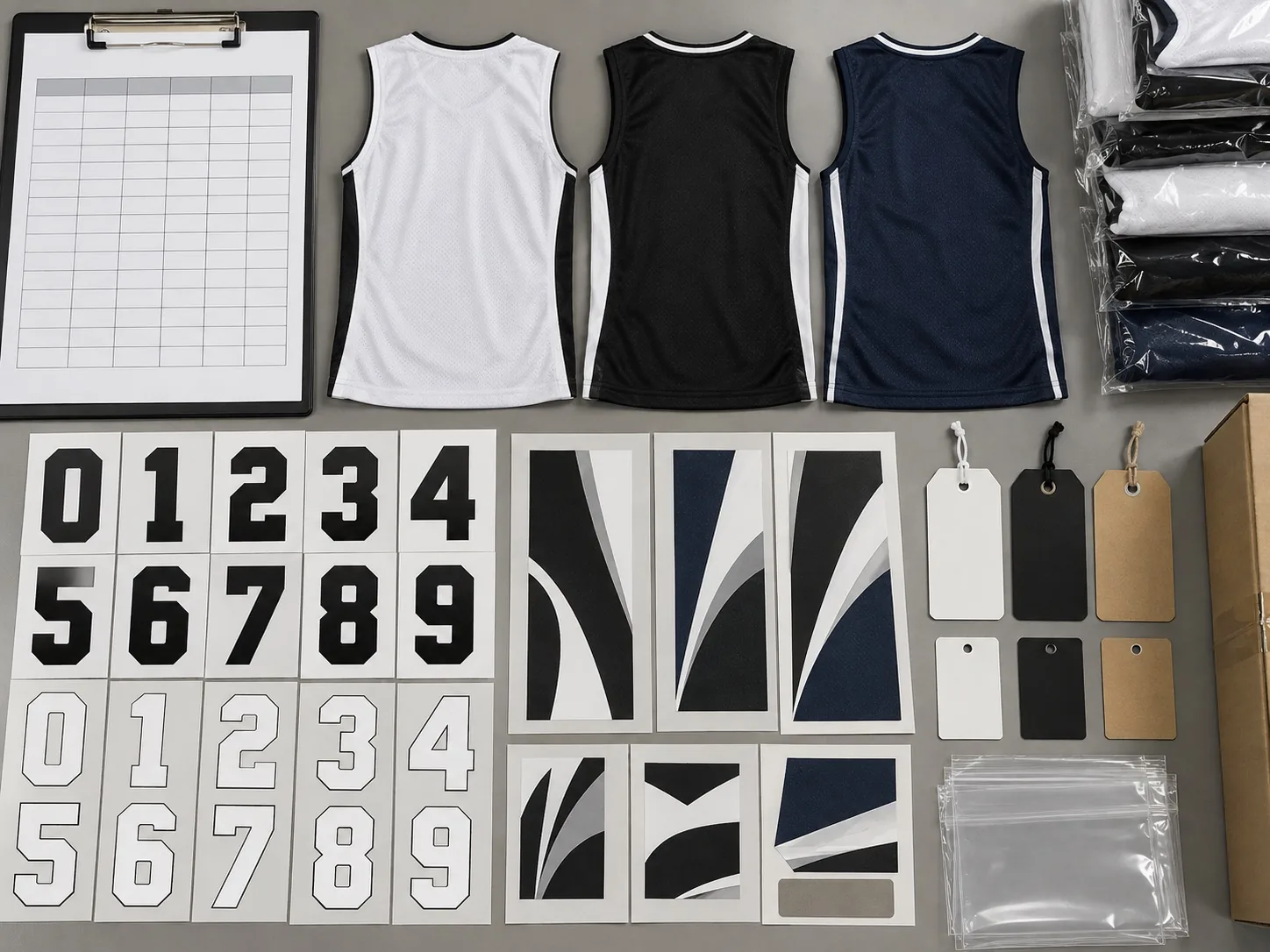
The decision in one paragraph
Tournament packing should begin with a role-product matrix, not with empty cartons. Give every team, wearer role, product and size allocation a controlled line ID; choose whether the inner pack is by named person, allocation code, size group or product; then group those packs into team or destination cartons. Reconcile ordered, accepted, packed and spare quantities at each level. The fields below are a planning template, not a record of a real KITOEM order.
Start with a role-by-product map
List every team and every role before quantities are allocated. Players, goalkeepers or liberos, coaches, officials, referees, volunteers and reserves can require different products, artwork and distribution times. A “tournament pack” is not one fixed product and should not hide those differences.
For each role, mark required, optional, organiser-supplied and participant-supplied items. Keep match garments, training layers, staff identification, bags and accessories as separate lines. One project can coordinate those lines, but every product still needs its own specification, unit, quantity, size reference and supply responsibility.
The matrix also exposes missing decisions. If referee shirts are required but specialist supply has not been confirmed, leave that line open rather than moving a player shirt into the official pack. If an event partner supplies medals, bottles or other non-apparel items, record the handover point without presenting them as KITOEM products.
| Role group | Possible apparel lines | Separate decisions |
|---|---|---|
| Players | Match kit, warm-up or training layer | Team, number, upper/lower size and issue method |
| Special player role | Goalkeeper, libero or alternate-colour item | Role-specific colour, artwork and quantity |
| Coaches and staff | Polo, training layer or outerwear | Staff identity, independent sizing and access needs |
| Officials and referees | Role-distinct apparel if confirmed | Rules, supplier responsibility and organiser approval |
| Reserves and replacements | Blank or allocated spare garments | Storage, authority to issue and post-event balance |
Choose the smallest unit that the organiser will actually hand out
Person-by-person packing works when each wearer has a fixed product and size allocation. Use the printed name only when production or handover requires it; otherwise an allocation code can reduce unnecessary personal data. Keep shirt and short sizes independent inside the pack.
Size-group packing may suit on-site issue when recipients are not final, but the organiser then owns fitting, queue control and leftover stock. Product-by-product packing can simplify bulk receiving yet moves the sorting work to the event team. Choose the method by the real handover workflow, not by the easiest carton arrangement.
Record how incomplete packs, late roster changes and unmatched items will be handled. A half-complete named pack should not be sealed and counted as ready without an exception marker.
Group inner packs into team, role or destination cartons
Give each carton a unique identifier within the project. Connect it to team, role or destination, then state the number and type of inner packs and any loose items. Keep the carton identifier on the packing list and receiving record so the organiser can locate an exception without opening the complete shipment.
A split shipment needs its own controlled totals. Reconcile what was ordered, what has passed inspection, what is packed in the first release and what remains for the second. Update the commercial invoice and packing list from the same accepted source. Do not correct only one document after a last-minute split.
GS1’s Logistic Label Guideline explains how a logistic unit can be identified and linked with related business information. A tournament project does not need to claim GS1 compliance unless the buyer actually requires and implements it. The practical lesson is to give every shipped unit an unambiguous ID and maintain the matching electronic record.
Keep spares and exceptions visible
Separate planned spares from named allocations. Record product, size, team compatibility, quantity and who may issue them. A spare shirt that carries a fixed player number is not interchangeable with blank stock; a goalkeeper colourway may serve only one role.
Use an exception log for missing, damaged, reworked or late items. Link each exception to the roster line, inner pack and carton. State whether the pack remains open, ships incomplete with written approval or moves to a later release. Do not hide shortages by reducing the packing-list total without a matching order decision.
If the organiser holds emergency stock at the venue, record the opening balance, issues and remaining quantity. This is an operational record, not an extra production promise.
Reconcile the roster, inspection record and packing list
Run control totals at four levels: complete project, team or delegation, product and size-personalisation line. The ordered quantity, accepted quantity, packed quantity, spare quantity and open exception quantity should explain one another. A correct project total does not prove that every team received the right mix.
Use the same stable line IDs from roster approval through inspection and packing. Re-sortable spreadsheets and exports should not rely on row number alone. Freeze a read-only packing version before dispatch and keep later corrections as dated changes.
Before sealing, sample-check person packs against the roster and team cartons against the packing list. If the buyer requires a formal sampling plan, define it separately. A few manual checks are useful process controls but should not be described as a statistical inspection unless the method supports that statement.
| Control total | What to compare | Typical exception |
|---|---|---|
| Project | All ordered lines versus all accepted and packed lines | An item missing from the full shipment |
| Team / delegation | Products and packs allocated to one team | Correct total shipped to the wrong team |
| Product / role | Player, goalkeeper, coach or official product totals | Role-specific item substituted or omitted |
| Size / personalisation | Roster line versus inner-pack contents | Wrong shirt size, short size, name or number |
| Carton / shipment | Packing list versus physical packed units | Last-minute split not reflected in documents |
Template: packing and distribution fields
The following fields are a reusable template. They are not populated from a real customer order. Delete fields that have no operational purpose and add buyer-required identifiers before production or packing begins.
| Level | Template fields |
|---|---|
| Project | Project ID; event; buyer; destination; required receiving date; packing revision |
| Team / group | Team code; role group; destination or handover point; group contact code |
| Roster line | Line ID; allocation code or approved name; product; colourway; upper size; lower size; number; quantity |
| Inner pack | Pack ID; roster lines included; packed by; check status; open exception |
| Carton | Carton ID; team or role; inner-pack count; loose items; gross weight if required; seal status |
| Shipment | Shipment ID; carton IDs; packing-list revision; commercial-invoice revision; dispatch handover |
| Distribution | Received by; received date; pack issued; exception raised; spare issued; closing balance |
Design the venue handover before dispatch
Name the receiver and the storage or distribution point for every shipment. Decide whether cartons move directly to teams, one event warehouse or several venues. Record access windows, contact codes and any re-sorting responsibility. Production completion, export dispatch, destination receipt and wearer handover are separate milestones.
Give organisers a readable packing list grouped in the same order as the physical shipment. Provide an exception list separately so an unresolved item is not buried in notes. If personal names are used, limit access and retention to the operational need.
At receiving, count cartons before opening, record visible damage, then reconcile team and person packs. Preserve photos and line references for shortages or wrong allocations before redistribution changes the evidence.
Close the record after distribution
Record undelivered packs, spare issues, returns and remaining blank stock. Separate a packing mistake from a roster change or no-show. That distinction determines whether the next action is supplier correction, organiser redistribution or a future replacement order.
Archive the final roster version, packing list, carton map, exception log and distribution balance. Remove personal data that is no longer needed while retaining product and version information required for legitimate repeat-order planning.
Use the close-out record to improve the next template. Add validation for the errors that actually occurred, but do not convert one tournament’s role mix, pack contents or spare quantity into a permanent rule for every event.
What to confirm for your project
- Team and role groups
- Products, units and independent size allocations
- Person, size-group or product-based inner-pack method
- Carton and shipment identifiers
- Spare and exception handling
- Roster, inspection, packing-list and invoice reconciliation
- Receiving, venue distribution and close-out responsibility
MOQ, sampling conditions, production timing, exact material options and service scope are confirmed for the specific product and order. This guide does not replace a current quotation, approved sample or production specification.
Questions to carry into supplier review
- Who needs a role-specific pack rather than the standard player allocation?
- Which identifier connects the roster, inner pack, carton and shipment?
- How will split shipments and post-inspection changes update every document?
Questions buyers ask next
Can tournament merchandise packs differ for players, coaches and officials under one project?
Yes as a planning structure. Keep each role’s products, sizes, quantities, artwork, supplier responsibility and packing rule separate. One project brief does not make every product identical or confirm every specialist supply route.
Can a tournament supplier provide referee shirts distinct from participant kits?
Treat referee apparel as a separate role-specific line and confirm rules, design approval and supply feasibility for the project. Do not infer official or referee supply from a player-uniform range.
How do we verify packing accuracy when the order contains reversible and single-sided jerseys?
Use different product codes, identify which side or artwork version governs each reversible item, and reconcile every inner pack and carton against the roster and packing list. Do not rely on a generic “jersey” description.
How do we prevent invoice and packing-list quantities from diverging after a split shipment?
Freeze one accepted allocation for each shipment and generate the packing list and commercial-invoice update from that source. Reconcile the first release, remaining balance and carton IDs before dispatch.
Should every player pack use the wearer’s name?
No. Use a name only when printing or distribution requires it and the buyer has a lawful operational basis. An allocation code can reduce unnecessary personal data while preserving traceability.
Technical references and buyer discussions
- Supply-chain identification guidanceGS1 — Logistic Label Guideline
Technical references explain the methods discussed. Public buyer discussions show how a problem is described in practice; they are not reports on KITOEM products or test results.