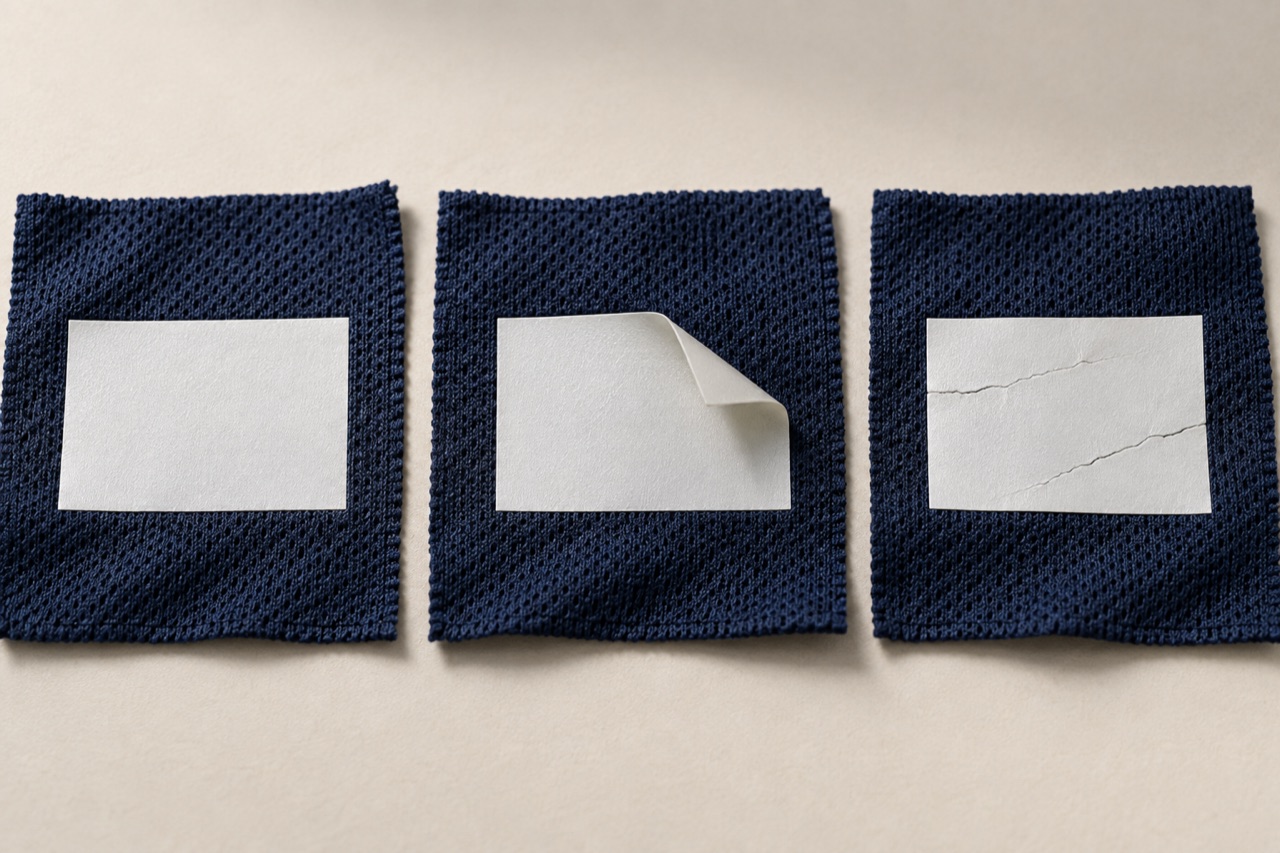
A shirt can still fit well and feel comfortable while its back number is already lifting. Calling this “poor printing” is understandable, but it does not tell a product developer what to change. The first useful step is to identify where the decoration has failed.
Look at the failure before choosing a remedy
An edge lifting away from the jersey raises a different question from a crack running through a number that remains attached. A white number turning pink is different again: the visible problem is colour change, not necessarily loss of adhesion.
| What you see | What to investigate |
|---|---|
| One edge or fine detail lifts | Local bonding conditions, contact with the platen, material compatibility and wear at that location. |
| The surface splits but stays attached | The decoration’s ability to move with the fabric, its condition and its use history. |
| The number changes colour | Dye migration or inadequate opacity, rather than assuming the adhesive has failed. |
This is a way to organise an investigation, not a diagnosis from a photograph. Keep an unused garment from the same batch alongside the returned item whenever possible.
A transfer belongs to a material system
A heat transfer must be suitable for the garment fabric. The specified time, temperature and pressure also belong to that particular transfer. Copying settings from a previous job can produce a convincing-looking result without establishing that the new combination is durable. STAHLS discusses these variables in its application guide.
“Polyester jersey” is not a complete production description. Record the actual fabric reference, transfer product, artwork dimensions and placement. A small chest mark and a large back number should each be reviewed in their intended location, rather than using one successful application to approve every decoration on the shirt.
Pay attention to the area beneath the number
Seams, collars and other raised features can interfere with even pressure. The operator needs to prepare the print area and use appropriate tooling, rather than simply increasing the heat. Different transfer products also need different pressure settings, as explained in the STAHLS pressure guide.
On a finished sample, inspect narrow strokes, corners and the parts of the design closest to seams. These locations deserve individual photographs. A single overall image can hide the first signs of lifting.
Keep colour change separate from peeling
On some polyester garments, dye can migrate into the decoration and alter its colour. This may appear after application rather than immediately. A more opaque print and a system designed to resist migration address different problems; the distinction is covered in the STAHLS dye migration handbook.
Read the edge, the face and the fabric separately
Start with the boundary between the number and the jersey. Is the edge still touching the fabric, or can you see a gap? Is the lifted part curled, folded or apparently undamaged? Does the change stop at a sharp corner, follow a long straight side or occur around the entire outline? These descriptions give the sample room something observable to investigate. “The print is bad” does not preserve this information.
Next, examine the face of the number. A fine surface line, a split through the decoration and a crease caused by folding can look similar in an online photograph. View the area relaxed, then move the garment gently within its normal wearing range. Record whether the line opens, closes or remains unchanged. Avoid probing under a sound edge with a fingernail, because that changes the sample you are trying to understand.
Finally, look at the surrounding fabric. Rippling, shine, local colour differences and a rectangular impression deserve separate notes. A securely attached number does not excuse an unacceptable change to the jersey beneath it. Equally, a visible fabric impression does not establish why an edge lifted. Treat appearance, attachment and fabric condition as three observations until there is evidence connecting them.
This separation is especially useful when reviewing returns remotely. Request one overall view, one view with the fabric relaxed and one close view of the affected boundary. An extreme close-up alone can obscure where the problem sits on the finished garment.
A name set and a back number are different development jobs
Artwork changes more than the appearance of a transfer. A name can contain thin strokes, isolated dots, acute corners and closely spaced letters. A back number may consist of broad continuous areas. Even when both use the same material, their geometry gives the reviewer different locations to examine. Approving a simple square does not answer every question about a detailed typeface.
Review the actual names and numbers at their intended dimensions. Identify the narrowest features, the smallest separate elements and any layered outlines. Ask whether those details are necessary to the design or whether a modest artwork adjustment would preserve the identity while making the finished result easier to reproduce. This is an artwork decision to evaluate with the decoration specialist, not a universal minimum stroke width.
Placement also changes across sizes. A number that sits comfortably on the flat back of a large jersey can occupy a much greater proportion of a junior shirt. The same nominal distance from the collar may bring another part of the artwork closer to a panel seam. Check the smallest and largest relevant garments instead of judging every size from a medium sample.
The finished appearance should remain intentional. Reducing a crest or name until its detail disappears is not a satisfactory manufacturing solution. A better development discussion makes the tradeoff visible: which elements can be simplified, which dimensions must remain fixed, and which decoration system can reproduce the required result on this particular jersey?
Why “more heat” is an incomplete correction
When an edge lifts, increasing temperature can feel like a direct response: stronger heating ought to mean stronger bonding. That assumption skips the actual material instructions. The transfer supplier specifies a combination of application conditions, including how the carrier is removed. A setting from a different product is not automatically an acceptable substitute. Consult the relevant product instructions, rather than treating a general online tutorial as the production recipe.
Before changing anything, establish what was actually used. Record the transfer reference and garment reference, the press involved, the application sequence and the carrier-removal procedure. A machine display is part of that record, but a written number alone does not demonstrate what happened across the entire decoration. Questions about equipment condition and verification belong with the equipment and transfer suppliers.
It is also useful to separate the original application from subsequent attempts to correct it. If someone has already repressed the sample, that is a different process history. Preserve an untreated example when available. Otherwise, the team may evaluate a repaired garment while believing it represents the original production method.
A controlled correction changes one defined part of the process and then evaluates the complete result. The number must attach satisfactorily, the fabric must remain acceptable, and the appearance must meet the brief. A change that solves one visible problem while creating another has not completed development. More heat, more pressure and more dwell time are variables to control, not quality grades.
The surface beneath the transfer deserves a closer look
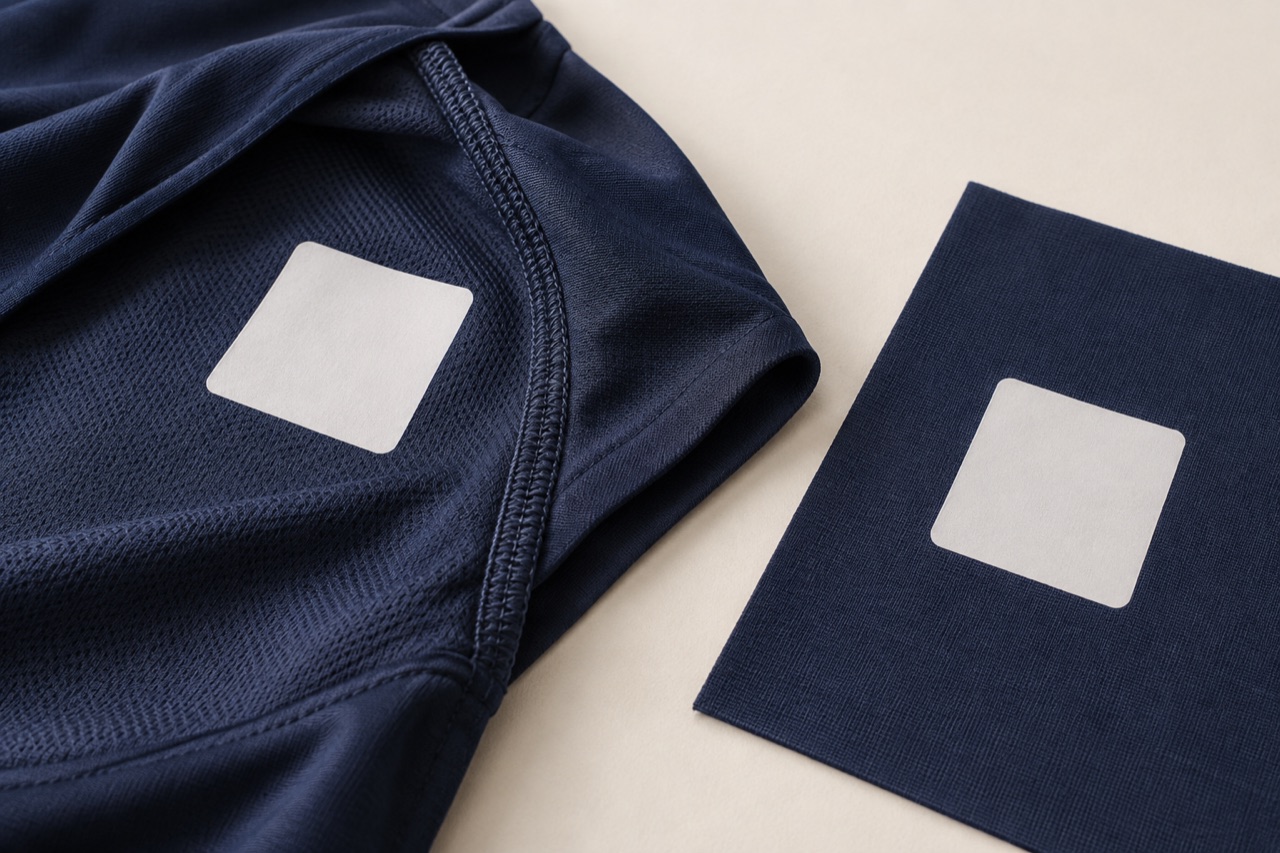
Finished garments rarely present a perfectly uniform application area. A nearby seam, a folded layer beneath the shirt or a section of trim can change the geometry of the stack. The practical question is whether the intended decoration area receives the appropriate contact for that transfer and press arrangement. It is not simply whether the shirt can be placed between the platens.
Examine the garment both right side out and inside out before application trials. Mark the proposed artwork position on a reference drawing and relate it to side panels, shoulder joins and any reinforcement. If different shirt sizes have different available space, document those differences. A placement template should reflect the garment construction rather than only the visual centre of an empty outline.
The fabric face matters too. Smooth jersey, textured knit and open mesh should not be treated as interchangeable surfaces merely because their fibre labels all say polyester. Ask the transfer supplier to assess the actual substrate. A loose swatch is useful for early screening; a finished garment establishes whether surrounding construction adds another difficulty.
Avoid improvising a stack of unverified padding materials and assuming that it reproduces an approved application. Appropriate pads, platens or other tooling must be selected and used according to the relevant guidance. The purpose is a reproducible setup. Once a setup works, retain enough information to reproduce it on the intended garment sizes, including the position of the decoration relative to raised features.
Stretch compatibility is about the decorated zone
Calling a jersey “stretchy” describes only part of the product. During wear, the fabric, decoration and nearby seams form an assembly. The decoration can feel noticeably different from the undecorated body even when nothing has visibly failed. For a fitted playing shirt, this difference deserves attention before the wash review begins.
Have the wearer perform movements relevant to the garment: reaching forward, lifting the arms or rotating the torso. Observe the decorated region without pulling the transfer independently. Does the panel move comfortably? Does the number form a pronounced fold? Does a broad graphic make the shirt feel more restrictive at that location? These are sample observations, not a substitute for a specified material test.
Compare designs at the intended coverage. A narrow outline, a solid number and a large sponsor block distribute decoration differently. It would be misleading to compare a tiny emblem made with one process against a large solid graphic made with another and attribute all differences to the process name. Hold the relevant artwork dimensions constant when making a direct comparison.
For cracking, inspect where the split occurs and whether it repeats in the same position on other garments. A repeated location can guide the next review without proving a single cause. Changes to transfer selection, graphic geometry or fit may all be candidates, but each should answer a defined observation. The objective is appropriate movement of the whole decorated zone, not maximum stretch in an isolated demonstration.
White numbers on dark polyester need their own colour review
Two visually similar complaints can require different conversations. A white number may look grey because the underlying colour is visible through the decoration, or it may develop an unwanted colour cast associated with dye movement. A photograph of the finished result does not always distinguish the two. Record the original colour, the timing of the change and the substrate involved.
A useful development record includes photographs shortly after the prescribed application and at subsequent agreed review points. Keep lighting and camera settings consistent enough to make the comparison meaningful. A new yellow room light or automatic camera correction can create apparent colour changes that were never present in the sample. Where colour acceptance is critical, agree on physical references and an appropriate evaluation method rather than relying entirely on phone screens.
Do not assume that adding another white layer solves every issue. More layers change the construction, and an opacity adjustment is not the same as selecting a suitable migration-resistant system. The transfer specialist should identify the material intended for the actual fabric and process. Then review its colour, surface feel and movement together.
Also evaluate each relevant garment colourway. Success on a white body does not establish suitability on a dark sublimated panel. If the shirt includes printed patterns beneath a sponsor mark, use that actual combination in development. A generic navy stock swatch may be a convenient starting point, but it is not necessarily the material on which the finished decoration will be applied.
Build a care review that can be interpreted
“Washed several times” is too vague to support a useful comparison. Record the care instructions followed, how the garment was prepared, the washing and drying conditions and when it was inspected. The purpose is not to invent a home laboratory. It is to ensure that two samples described as receiving the same treatment actually have comparable histories.
Photograph the starting condition before the first wash. Note any tiny lifted corner, surface crease or fabric impression already present. Otherwise, a later reviewer may attribute a pre-existing feature to laundering. Keep a separate unused reference where practical, and identify each garment so photographs cannot be confused between versions.
Inspect after the garment has reached the agreed dry and relaxed condition. Do not pull it into a flattering shape for the photograph. Record attachment, cracking, colour and fabric appearance separately. A number may remain attached while its surface appearance changes, or preserve its colour while one edge begins to lift. A single pass-or-fail box can conceal these distinctions during development.
Use the intended care instructions as the starting point for evaluation. If investigating a return, record any known differences without immediately blaming the wearer. Unknown care history is an evidence gap. It does not prove misuse. Similarly, one successful wash trial does not justify an unlimited durability promise. State exactly what was reviewed and reserve broader claims for evidence appropriate to those claims.
A worked example: the same corner keeps lifting
Imagine a development sample with a narrow white name above a large back number. After the agreed care review, one lower corner of the number lifts while the name remains intact. This is a hypothetical example, not a customer case or a reported KITOEM test. Its value is in showing how to organise the next step.
Begin by locating that corner on the garment drawing. Compare its position with seams and any layers beneath the application area. Check whether the feature appears on more than one sample and whether their application histories match. The intact name is useful context, but it does not prove that every part of the number received the same conditions.
Next, inspect an unused decorated garment and an undecorated garment of the same construction. Ask the decoration specialist to review the transfer choice and recorded setup. If the evidence suggests a local contact issue, make a controlled sample using the corrected approved setup while keeping artwork and materials unchanged. If compatibility remains uncertain, evaluate an appropriate alternative in a separate comparison.
The review should then return to the original observation: did that corner remain satisfactory under the same documented sequence? Also inspect the rest of the number and the fabric, because a correction can introduce a new problem elsewhere. This approach produces a traceable development decision. Simply repressing the returned shirt until it looks better produces a repaired object, but very little reliable information about prevention.
Three questions that come up during sample reviews
Does a sharp edge automatically mean the transfer is poorly bonded? No. Edge appearance and attachment are different observations. A crisp outline may be intentional, while a visible gap between the decoration and fabric deserves investigation. Examine the relaxed sample without picking at the boundary. The review should establish whether the actual edge meets the approved appearance and remains attached under the documented conditions.
Can one successful material be used for every mark on a team kit? It may be suitable for several applications, but that needs to be established. A small mark on shorts, a broad back number and a chest emblem can involve different fabrics, placement and movement. Record the approved combinations instead of extending one result across the entire collection by assumption.
Should a peeling number always be repaired before returning the garment for review? If the purpose is to investigate the original problem, preserve its received condition first. Photographs and an untouched representative sample can be more useful than a repaired appearance. Any later intervention should be recorded separately, including who performed it and which product guidance was followed.
These questions share one practical point: a visible result belongs to a specific construction and history. Keep those details attached to the sample. They allow the next decision to respond to evidence rather than to a general belief about heat transfers. The process becomes easier to improve when the team can distinguish what it observed, what it suspects and what it has actually changed.
What to record when approving the finished number
Keep the approved sample with a concise decoration record. Include the actual material references, finished artwork dimensions, placement references and the relevant application instructions. Record any approved tooling arrangement and identify which garment sizes or constructions were evaluated. This information connects the visual approval to the product that created it.
Define acceptable appearance in language that a reviewer can use. For example, specify that edges should remain fully attached in the reviewed condition, narrow details should remain legible, and the surrounding fabric should not show unacceptable distortion. If a measurable tolerance or formal test requirement is needed, agree it explicitly with the relevant specialists. Do not turn an informal visual preference into an invented industry standard.
Keep the evidence boundaries clear when describing the result. “Reviewed on this jersey after the documented care sequence” is narrower and more useful than “permanent printing.” A retained sample, dated photographs and a readable process record allow later questions to be investigated without relying on memory.
For the wearer, the most useful care advice is the guidance validated for the complete garment and decoration combination. For the product developer, the most useful approval is a system that can be repeated. A good-looking number matters, but its real value comes from continuing to work with the fabric, shape and use of the shirt.
Evaluate the decorated garment, not only a loose transfer
Prepare a repeatable review using the intended jersey, the actual artwork and the agreed care instructions. Photograph it before wear, after normal movement and after the agreed wash sequence. Record whether the observation is edge lift, cracking, colour change or fabric distortion. This is a development record; it should not be presented as a certified durability result.
For a damaged shirt, document the care history before attempting a repair. There is no universal ironing setting that safely repairs every number. The useful product question is whether the fabric, decoration and application process work together under the conditions the garment is expected to face.
Technical references and question evidence
- TechnicalSTAHLS: Heat Press Application 101
- TechnicalSTAHLS: Pressure Settings
- TechnicalSTAHLS: Dye Migration Handbook
- Question evidence onlyPublic discussion of washed jersey decoration
Technical references support the discussion method. Question evidence documents public discussion of an issue; it does not diagnose a KITOEM product or establish a test result.