
The decision in one paragraph
Supporting accessories should not disappear inside a kit total. Record every product, quantity, size or finished dimension, material reference, artwork method and approval route. Different sock lengths or accessory constructions remain separate specifications unless the quotation explicitly combines them.
Create one line for every accessory
A football sock, crew sock, cap, armband and towel have different measurement, material and production needs. Keep each item and quantity visible.
Do not assume an accessory shares the garment minimum, delivery window or replacement route.
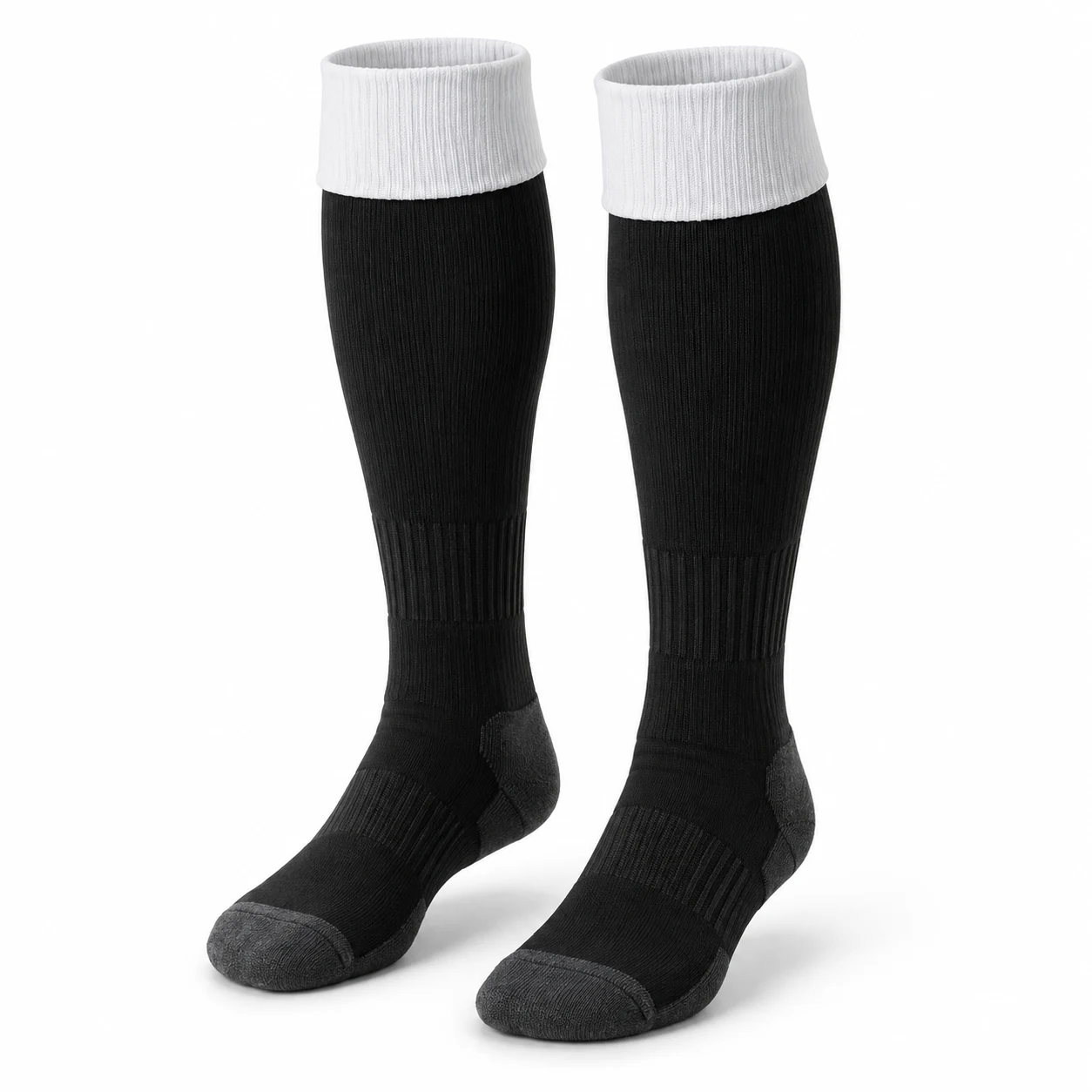
Specify socks beyond youth or adult labels
Record an agreed size range and finished length measurement point for each group. Add yarn or fabric reference, cuff, foot construction and artwork method where relevant.
Long and short socks are separate specifications unless the quotation states that they can share a minimum.
Use the right measurement for each product
| Product | Useful specification inputs |
|---|---|
| Cap | Head range, crown, closure and artwork area |
| Armband | Finished width, circumference range and closure |
| Towel | Finished dimensions, edge and branding method |
| Shin guard | Intended user, dimensions and product review route |
Scale artwork on the actual product area
Provide the final physical size and placement rather than one logo file with no product context.
Small knit, curved or elastic surfaces may require a different artwork decision from the match shirt. Approve the real method and substrate together.
Keep accessory quantities visible in packing
State whether accessories are paired, individually packed, bundled by player or supplied in bulk.
The packing list should reconcile ordered quantities, spare items and any size or colour split.
Resolve the unit and variant matrix first
Write the commercial unit beside every quantity. Socks may be requested as pairs; a towel or cap needs its own piece count; an assembled player pack must list its exact contents. Do not transfer a garment set count into accessory totals until the issue plan actually defines that relationship.
Give long and short sock directions separate rows with their size ranges and agreed length measurement points. A common logo or colour can connect them visually, but it does not prove a shared yarn run, minimum or production schedule. Ask which aspects can be coordinated and which remain separate sourcing decisions.
| Accessory | Variant information | Review evidence |
|---|---|---|
| Football socks | Size range, length point, colour and pair quantity | Actual knit or construction proposal and fit reference |
| Cap | Head range, closure, crown and artwork area | Closure adjustment and decoration trial |
| Armband | Finished width, circumference range and closure | Fit, overlap and mark visibility |
| Towel | Finished dimensions, edges and decoration | Actual surface and edge sample |
Choose artwork for the product area, not the jersey mock-up
A mark that works on the front of a shirt can be unsuitable when reduced onto a sock cuff, curved cap panel or adjustable armband. Send the final physical size, orientation and critical small details for each item. Ask the supplier to propose the actual method on the actual material; a digital mock-up cannot settle the resulting edge, hand feel or readability.
Compare the method choices through a trial and their effect on the product’s intended use. A woven or knitted identity, an applied mark and a printed mark are different proposals, not interchangeable guarantees. Keep any stretch, comfort or colourfastness claim tied to relevant evidence rather than assuming that the shirt’s approval covers every accessory.
Design the packing list around distribution
Illustrative planning scenario: a school orders socks by size while volunteer caps are issued without player names. Keep the two issue rules separate. Reconcile totals by accessory variant, including the spares the buyer has actually requested. The packing list should allow a distributor to identify a carton’s contents without opening every individual pack.
Where the buyer’s logistics system needs GS1 identification, request its assigned identifiers and label requirements. GS1 describes an SSCC as identification for a logistics unit, such as a case or parcel; it is not the same as a wearer name or a sock-size field. Do not invent retail codes. Common errors include counting sock pieces as pairs, leaving cuff length undefined and bundling an unapproved accessory inside a garment set.
- Commercial unit for every accessory
- Variant quantities and size or length reference
- Material and construction proposal
- Final-size decoration trial
- Buyer-provided distribution or label fields
- Reconciled packing and spare quantities
What to confirm for your project
- Product and commercial unit
- Quantity by size, length or variant
- Material and construction reference
- Final artwork size and method
- Minimum and reorder basis
- Packing and reconciliation rule
MOQ, sampling conditions, production timing, exact material options and service scope are confirmed for the specific product and order. This guide does not replace a current quotation, approved sample or production specification.
Questions to carry into supplier review
- Are socks quoted by pair or piece?
- Can two lengths share a yarn run?
- Which products are bundled by player?
Questions buyers ask next
How should football socks appear in a mixed garment enquiry?
Use a separate sock line with its unit, pair quantity, size range, length reference and decoration requirement. The garment count should not silently determine the sock quantity.
Can long and short socks automatically share one minimum?
Do not assume that. Ask how the proposed constructions, colours and production groups affect the quotation. A shared visual identity does not establish a common minimum or reorder condition.
Why should artwork be approved separately on a cap or armband?
The area, curvature, material and adjustment can differ from a shirt. Approve the real mark at its intended size and position on the relevant product, not merely the same artwork file.
Should every accessory have the same performance claims as the kit?
No. Yarn, fabric, construction, decoration and use can differ. Any stretch, resistance or colourfastness requirement needs a relevant product proposal and an agreed evidence basis.
What keeps player packs from hiding accessory shortages?
An explicit contents list and variant-by-variant reconciliation. Count each ordered unit, the buyer-approved spares and the quantity inside each pack; a carton total alone does not establish that every wearer receives the correct items.
Technical references and question evidence
- Technical referenceISO 8559-1:2017 — Anthropometric definitions for body measurement
- Technical referenceAdobe — Produce print-ready PDF files in InDesign
- Technical referenceGS1 — Serial Shipping Container Code identifies logistics units
Technical references support the discussion method. Question evidence documents public discussion of an issue; it does not diagnose a KITOEM product or establish a test result.