
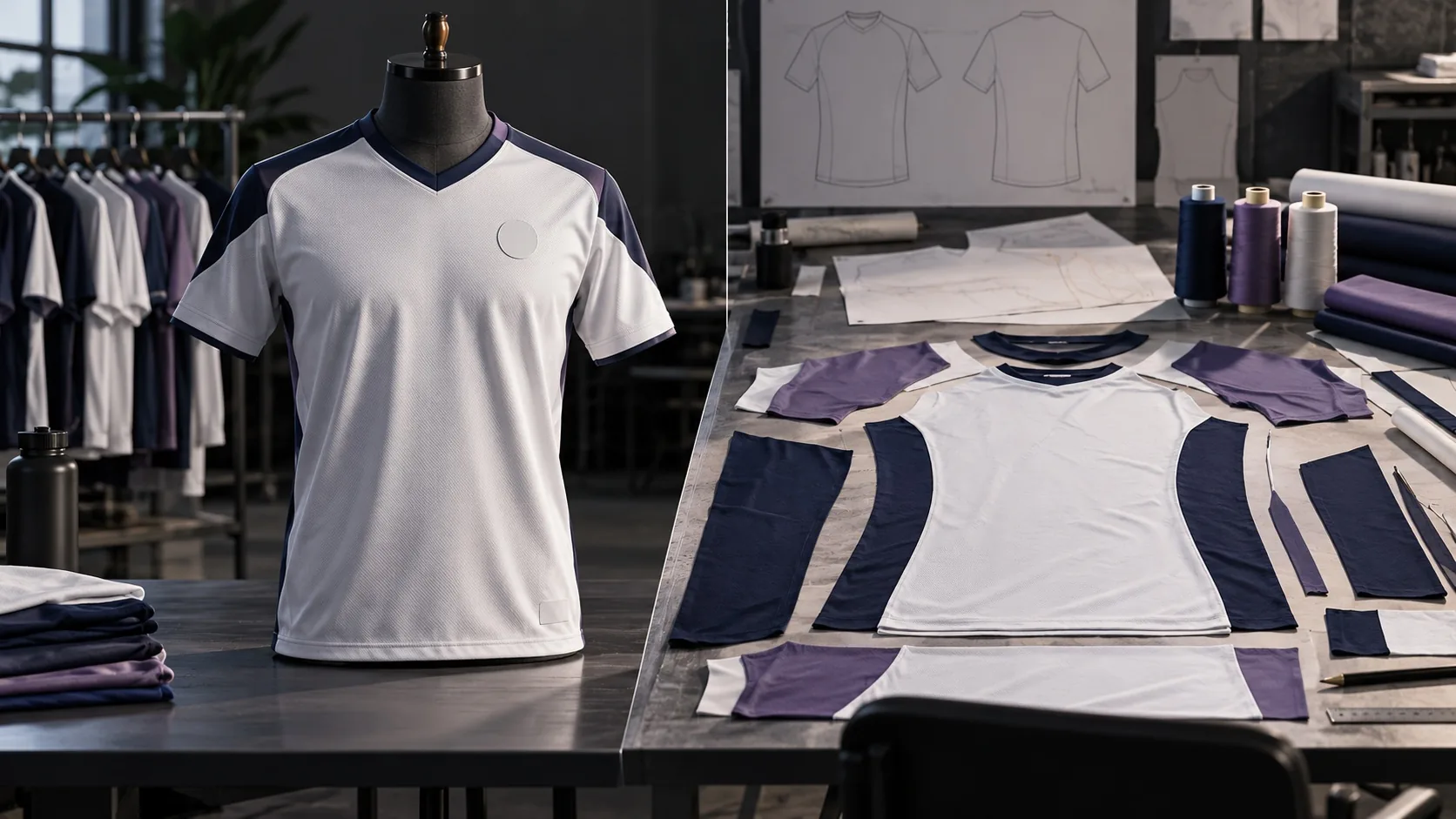
The decision in one paragraph
Choose stock customisation when an existing garment already fits the use, size range and colour direction and only controlled decoration is needed. Choose cut-and-sew when the product itself must change—its pattern, panels, fabric, trims, construction or full-coverage artwork. Neither route is automatically faster, cheaper or better. Compare the exact product, quantity, decoration, sample scope, repeat-order plan and required arrival date before selecting a route.
Start with what must change
The useful distinction is not “simple” versus “premium.” It is whether the buyer is changing a finished garment or developing the garment itself. Stock customisation begins with an existing, confirmed product and adds approved elements such as a crest, sponsor mark, name, number or label. Cut-and-sew begins with garment requirements and creates panels, construction and artwork around the approved specification.
Write two lists before asking for a quote: decisions that may stay standard and decisions that must be unique. If a standard fit, fabric, colour and size range already work, changing the whole garment can add development work without adding buyer value. If the brief requires a new collar, panel map, fit block, pocket, trim system or all-over artwork, a stock route may force compromises.
Compare the routes on the same brief
| Decision | Stock garment + customisation | Cut-and-sew development |
|---|---|---|
| Base product | A confirmed existing style and available colour/size scope | A product specification developed for the project |
| Artwork | Usually discrete placements within compatible zones | Can be integrated across panels, subject to construction and process |
| Sampling | Decoration proof or decorated garment may be sufficient, depending on risk | Fit, construction, material and decoration may need separate approval stages |
| Quantity | Depends on confirmed stock and the selected decoration process | Depends on material, process and production setup; quote per project |
| Repeat orders | Depend on continued stock and decoration references | Depend on retained files, approved version and material availability |
| Timing | May reduce product-development time, but stock and decoration still need confirmation | Includes development and approval work before production timing can begin |
Do not treat stock as permanently available
“Stock style” describes a product route, not a guarantee that every colour and size is available today. Ask the supplier to identify the exact style, current stock status, allocation period and what happens if a size sells out before approval. If the project has a fixed event date, require a dated availability confirmation and an alternative plan.
For KITOEM enquiries, confirmed in-stock products may be discussed against a 7–10-day dispatch window, while available-stock customisation is normally planned within 15 days after artwork and order confirmation. These are conditional planning references, not universal promises and not arrival dates. The exact trigger, process, quantity and stock must be confirmed in the quotation.
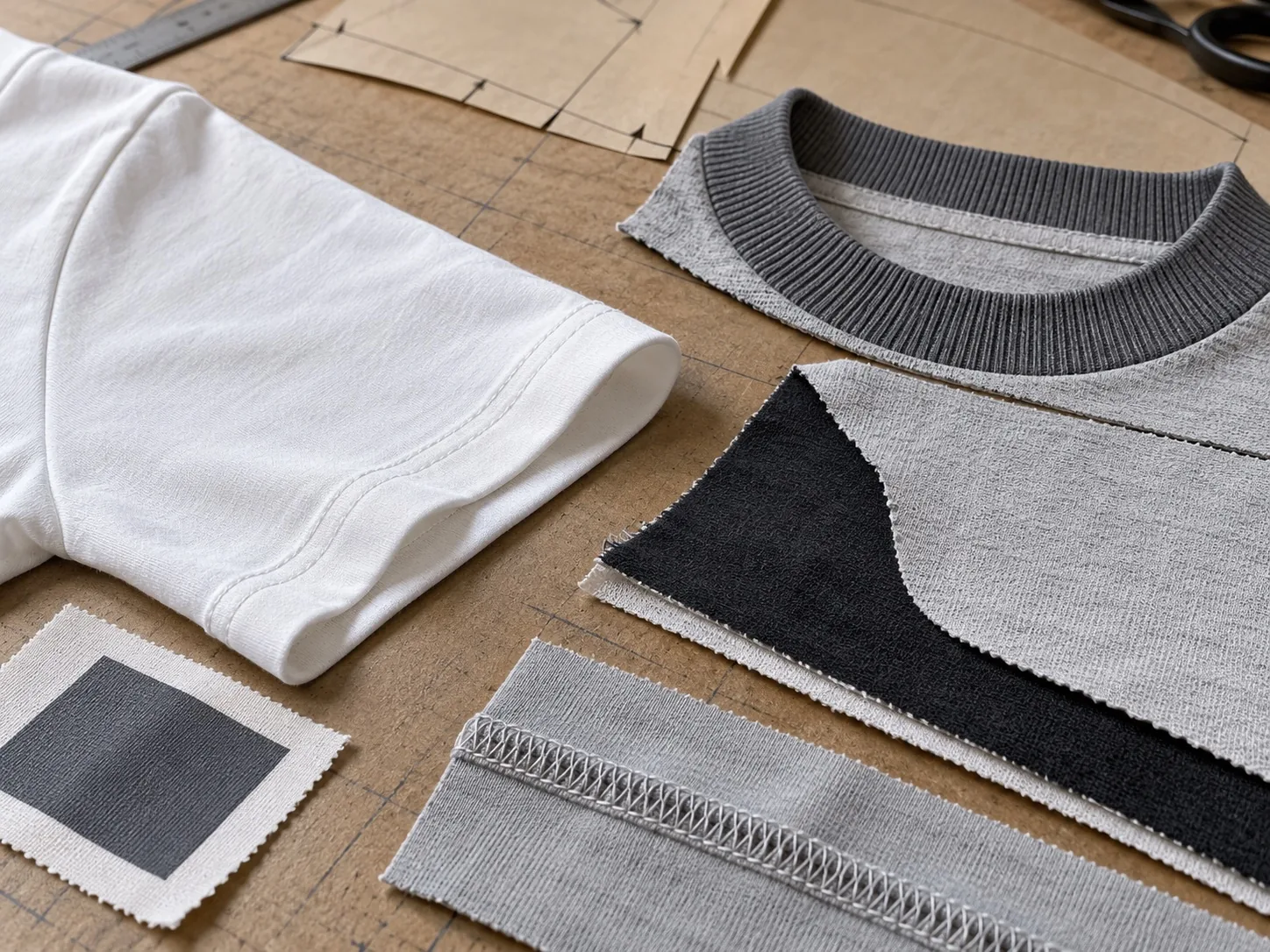
Make cut-and-sew approvals explicit
A cut-and-sew quotation should identify the proposed fabric, pattern or fit basis, garment construction, colour and artwork route, trims, labels, packing, size range and sample scope. “Fully custom” is too broad to price or approve. Every substitution should require written approval.
KITOEM currently uses an approximate 25-day production planning reference for fully custom work after the written production trigger. Sampling is discussed separately and remains project-specific. These references exclude feedback, revisions, freight, customs and final delivery. A current project quotation must define the trigger and calendar basis.
Use a decision test, not a preference
- Can an existing garment satisfy the wearer, fit and size-range requirement?
- Does the artwork fit within compatible decoration zones?
- Is current stock confirmed for every required colour and size?
- Does the product construction itself need to change?
- What sample must approve fit, material, construction and decoration?
- Which route is easier to repeat under the buyer’s expected reorder pattern?
- Which date is fixed: artwork approval, dispatch or arrival?
Build the RFQ so both routes can be compared
Ask suppliers to quote the closest stock route and the proposed cut-and-sew route against the same item list, quantities, artwork, size range, destination and required arrival date. Require each quote to state assumptions and exclusions. A lower unit price is not comparable if it omits labels, personalisation, sampling, packing or freight.
The best route is the one whose limitations the buyer can accept and whose approvals can be completed before the required date. If neither route is clear, start with a sample or product-reference review instead of forcing a bulk quotation.
What to confirm for your project
- Existing product reference and live stock status
- Exact changes required
- Decoration and material compatibility
- Sample scope and approval authority
- Quantity by item, colour and size
- Production trigger and dispatch basis
- Repeat-order dependency
MOQ, sampling conditions, production timing, exact material options and service scope are confirmed for the specific product and order. This guide does not replace a current quotation, approved sample or production specification.
Questions to carry into supplier review
- Which product decisions can stay standard?
- Which construction or artwork decisions require a new product?
- What depends on stock continuity or retained production records?
Questions buyers ask next
Is stock customisation always cheaper?
No. It can avoid some product-development work, but cost still depends on the garment, decoration, quantity, personalisation, handling and packing. Compare complete quotations.
Can a stock garment use full-coverage artwork?
Usually not in the same way as artwork integrated before panel cutting. Ask what printable zones and processes are compatible with the finished garment.
Is cut-and-sew always a high-MOQ route?
Not as a universal rule. Minimums depend on material, process, setup and supplier. Request a project-specific minimum and the cost drivers behind it.
Which route is better for reorders?
Either can work if dependencies are controlled. Stock reorders depend on continued availability; cut-and-sew reorders depend on retained specifications, approved versions and material continuity.
Technical references and buyer discussions
- Technical referenceEpson — A digital printing primer
- Technical referenceEpson — Direct-to-film printing guide
- Technical referenceAvient — Dye migration technical bulletin
Technical references explain the methods discussed. Public buyer discussions show how a problem is described in practice; they are not reports on KITOEM products or test results.