
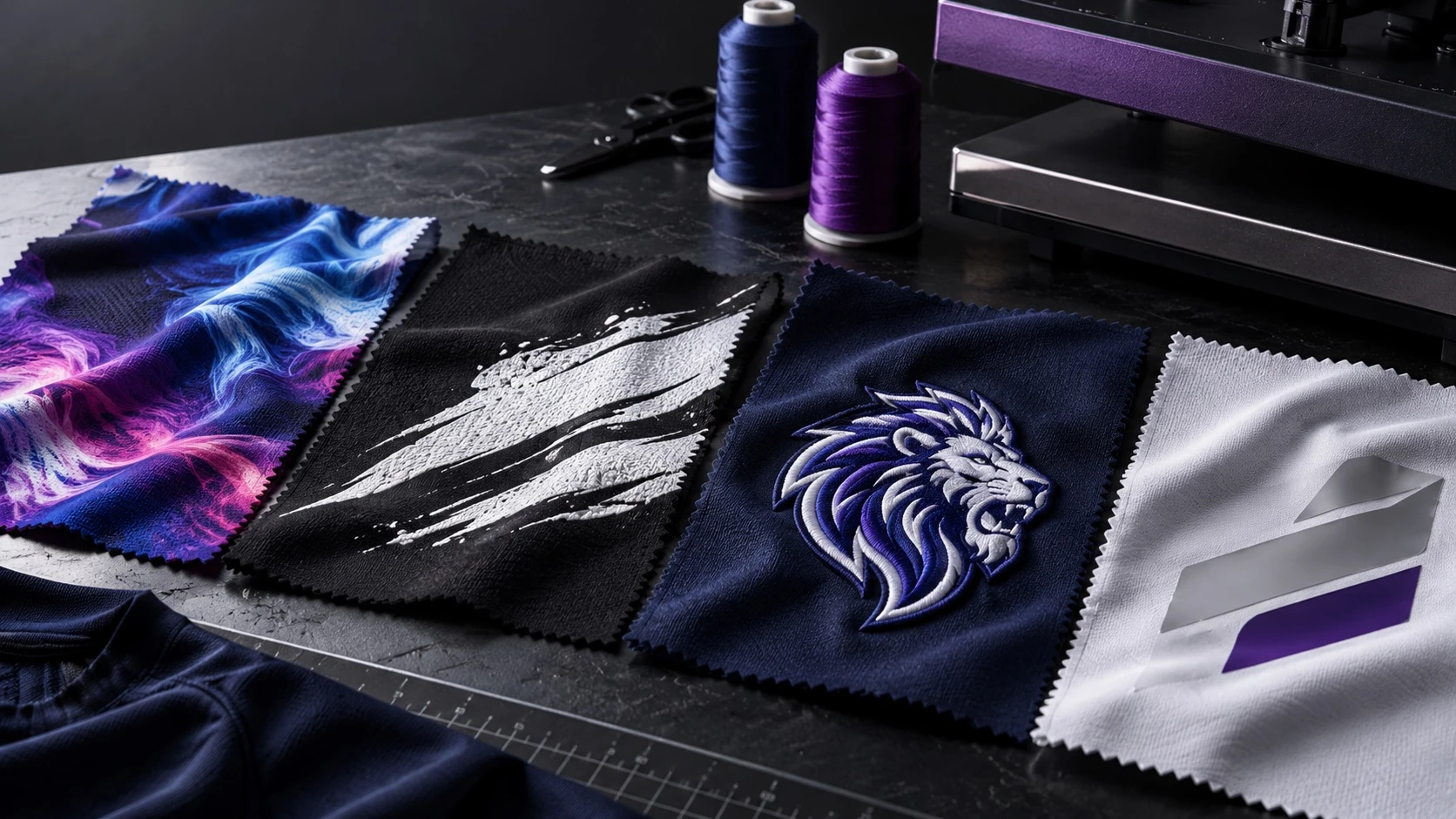
The decision in one paragraph
Compare the two routes against the actual garment and artwork. An existing football shirt may suit a limited badge or name application if its fabric and placement are compatible. A fully custom kit allows a broader design brief, but construction, material, artwork, quantities and sample approval still require separate agreement. Neither route guarantees stock or a fixed lead time.
Match the method to the whole garment
A crest that works on a cotton-rich training top may not behave the same way on dark polyester matchwear. A full-panel graphic may need artwork prepared before cutting, while a roster name may be applied after the garment is assembled. Start with the exact product, material, colour, panel map and artwork element.
Separate every element in the brief: base artwork, crest, sponsor mark, player name, number, private label and packing identification. One garment can use more than one method, but later heat, stretch and care can affect earlier processes. Approve the finished construction.
Compare methods by decision—not slogan
| Method direction | Useful starting point | Approval focus |
|---|---|---|
| Dye sublimation | Broad or panel-level colour on compatible white/light polyester or polyester-rich material | Colour, panel registration, show-through, hand, shade and finished seams |
| Applied film or transfer | Discrete crests, sponsors, names, numbers or labels | Substrate compatibility, heat effect, edge bond, opacity, stretch and migration |
| Direct-to-garment | Some cotton or cotton-rich garments, subject to equipment and pretreatment | Fabric blend, pretreatment, colour, hand, curing and wash review |
| Screen printing | Repeated spot-colour graphics when ink and setup suit the substrate | Ink system, opacity, registration, hand, curing and polyester migration risk |
| Embroidery or patch | Structured marks where weight, backing and stitch path suit the garment | Distortion, backing, edge finish, skin contact, placement and puckering |
Understand sublimation boundaries
Dye sublimation transfers dye into compatible material rather than placing an opaque white ink on top. It is commonly associated with white or light polyester-based substrates. The finished feel can remain close to the fabric because there is no separate film layer, but colour, garment construction, seams and fabric performance still require approval.
Do not promise “never fades” or “cannot crack” as a complete durability statement. Sublimation avoids some film-edge failure modes, but the garment can still have colour, pilling, snagging, dimensional or sewing issues.
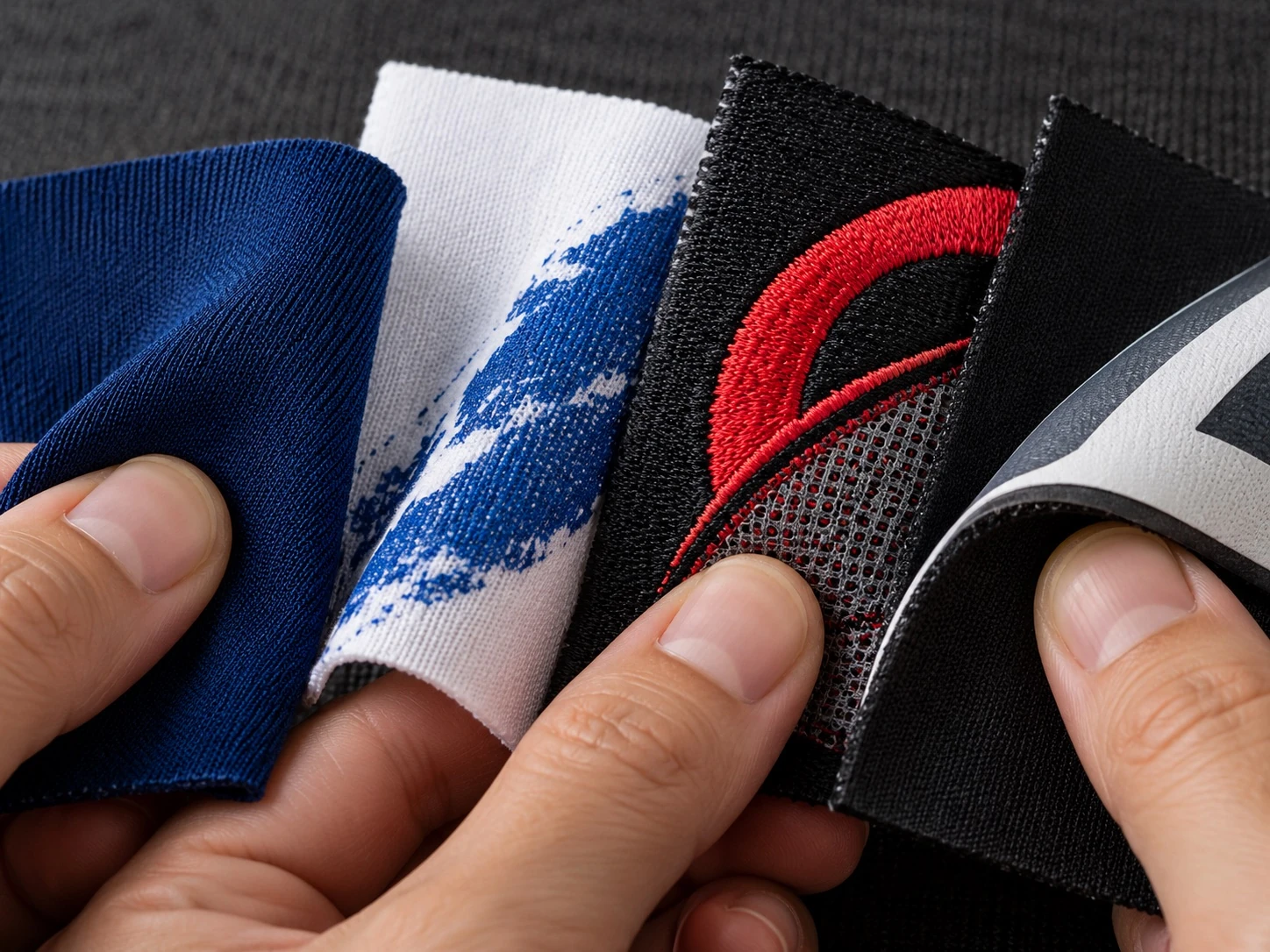
Control heat and migration on polyester
Heat-applied decoration on dyed polyester can be affected by dye migration, heat sensitivity or surface change. Ask the supplier to identify the material, ink or transfer system, application conditions and any blocker or low-temperature route. Pretest the actual garment colour and construction.
A passed test on one colour or fabric does not automatically cover the full range. Dark colours, finishes and recycled or mixed materials can behave differently. Keep the approved sample and process reference connected to the order.
Approve production-scale artwork
- Vector or production-ready artwork and named colour references
- Final mark size and location by garment size
- Panel and seam interaction
- Small-text and line-width limitations
- Roster font, spelling, numbering and replacement policy
- Private label, care label and packing mark separately
- Sample method, care review and acceptance criteria
- Written approval for any process or material substitution
Ask for a method recommendation with evidence
A useful supplier response should explain why a method fits the exact garment and what must be sampled. If the supplier proposes an alternative, ask what buyer requirement changes: colour, hand, placement, minimum, cost, timing, care or repeatability.
When discussing a KITOEM project, include the exact garment, material, colour and artwork element in the enquiry. The current quotation and sample plan should identify the selected process, the production route and the approval evidence required for that item.
Connect football artwork to neckline and sleeve choices
A sponsor layout should be reviewed on the garment shape it will use. The neck opening, polo placket, sleeve seams and side panels change the usable zones. Compare a front/back mockup with the requested collar and short- or long-sleeve direction before approving mark size and placement.
KITOEM’s seven local football references are V Neck-A, V Neck-B, Round, Full Polo, Half Round Stub, Insert Panel and Two Panel. These are house design names supported by structural drawings. Keep the option code with the artwork revision, then review the actual collar finish and dimensions on the sample.
Keep full sublimation artwork separate from any applied crest, private neck label or packing mark in the specification. A shared colour palette does not make all substrates and decoration routes interchangeable. Confirm each selected method and garment zone as part of the project.
What to confirm for your project
- Exact garment and fabric
- Artwork element by element
- Method and responsible production route
- Heat and migration risk
- Production-scale placement
- Sample and care review
- Roster and repeat-order control
MOQ, sampling conditions, production timing, exact material options and service scope are confirmed for the specific product and order. This guide does not replace a current quotation, approved sample or production specification.
Questions to carry into supplier review
- Which decoration method fits the actual substrate?
- What must the sample prove at production scale?
- How will names, numbers and replacements be controlled?
Questions buyers ask next
Which sportswear printing method is best?
No method is universally best. The right choice depends on the exact fabric, colour, artwork, construction, quantity, use and care requirements.
Can sublimation print white?
Conventional sublimation relies on the light substrate for white areas rather than applying opaque white ink.
Can one jersey combine sublimation and transfers?
Yes in principle, but approve the finished sequence because later heat and substrate dyes can affect the result.
Is embroidery suitable for lightweight jerseys?
Sometimes, but weight, backing, puckering, skin contact and placement must be evaluated on the actual garment.
How should names and numbers be controlled?
Use one final roster with approved font, scale, placement and version. Treat every later change as a controlled exception.
Technical references and buyer discussions
- Technical referenceEpson — A digital printing primer
- Technical referenceEpson — Direct-to-film printing guide
- Technical referenceBrother — GTX compatible items and substrate guidance
- Technical referenceAvient — Dye migration technical bulletin
Technical references explain the methods discussed. Public buyer discussions show how a problem is described in practice; they are not reports on KITOEM products or test results.