The decision in one paragraph
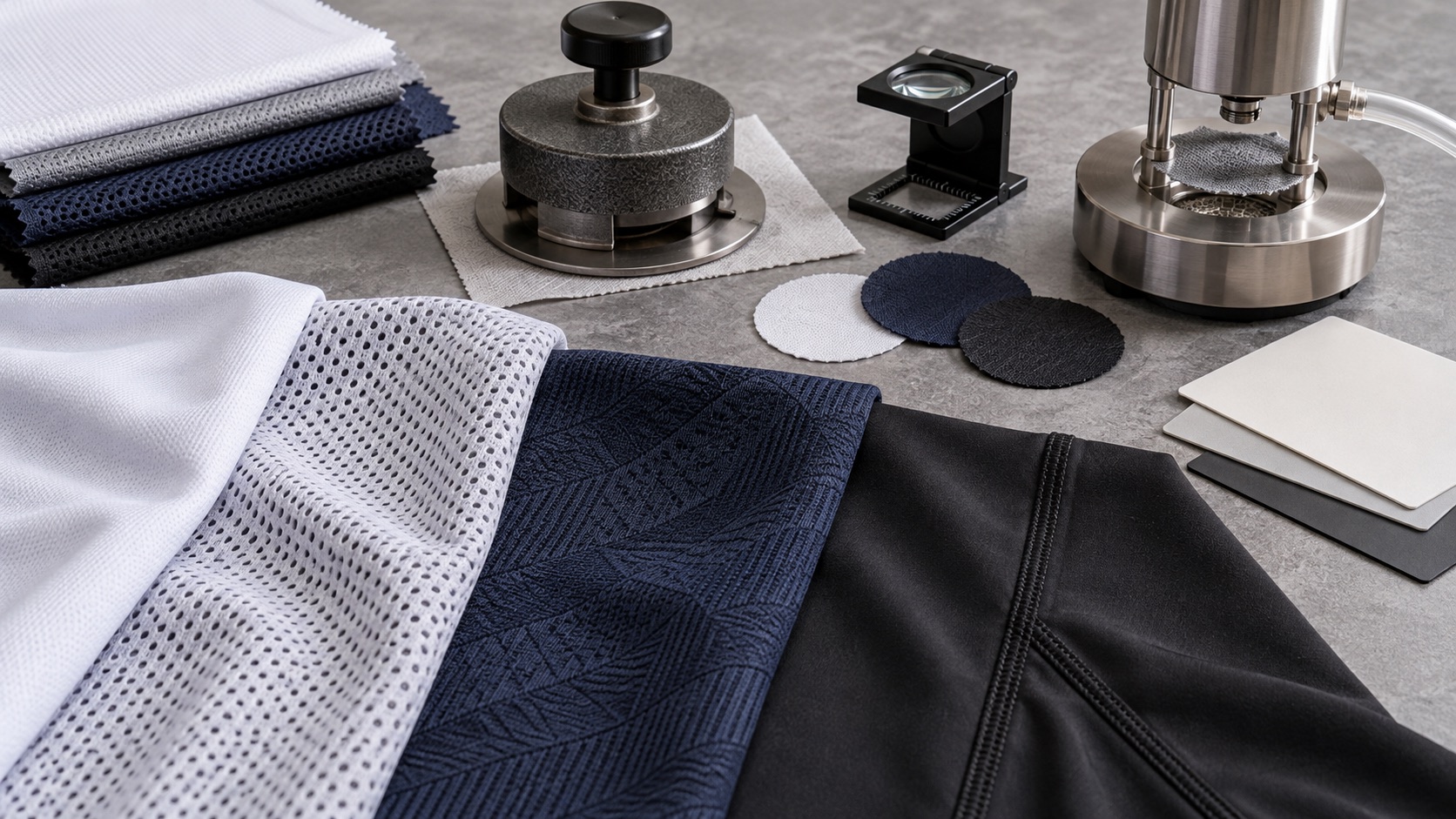
Start with the wearer, sport, climate, fit, artwork and care conditions. Identify the actual fabric by supplier reference, fibre claim, knit structure, finish, colour and lot. Compare mass per unit area, thickness, air permeability, stretch and recovery, moisture behaviour, opacity, abrasion or snag risk, colourfastness and dimensional change only where they matter to use. Ask for the test method, sample identity, result, date and laboratory rather than accepting “breathable” or “quick dry” as evidence. Finally, approve the material in a finished garment because seams, panels, print and fit alter performance.
1. Write the use case before comparing swatches
A useful fabric decision begins with sport, intensity, weather, duration, contact, layering, fit, wearer group, artwork coverage and laundering. A lightweight open mesh can support ventilation but create opacity, snagging or print-detail concerns. A smooth dense knit may present graphics well but feel warmer. No structure is universally “best.”
Separate match, training, goalkeeper, travel and retail requirements. Goalkeeper elbows and shoulders may face different abrasion and padding interactions; youth kits may need robust laundering; a race shirt may prioritise low mass and wet comfort. If one fabric is proposed for every product, check whether that is a deliberate system or a purchasing convenience.
Turn marketing language into questions. “Breathable” becomes air permeability under a stated method. “Moisture wicking” becomes a defined liquid-moisture behaviour. “Durable” becomes resistance to the failure modes relevant to use, such as abrasion, pilling, snagging, seam damage, print change or dimensional instability.
2. Identify what the fabric actually is
Record supplier reference, claimed fibre composition, knit structure, mass, width, colour, finish and lot or sample date. Preserve a labelled swatch. Terms such as birdseye, interlock, mesh and jacquard can describe broad families with many constructions; compare the physical sample and specification rather than relying on the name.
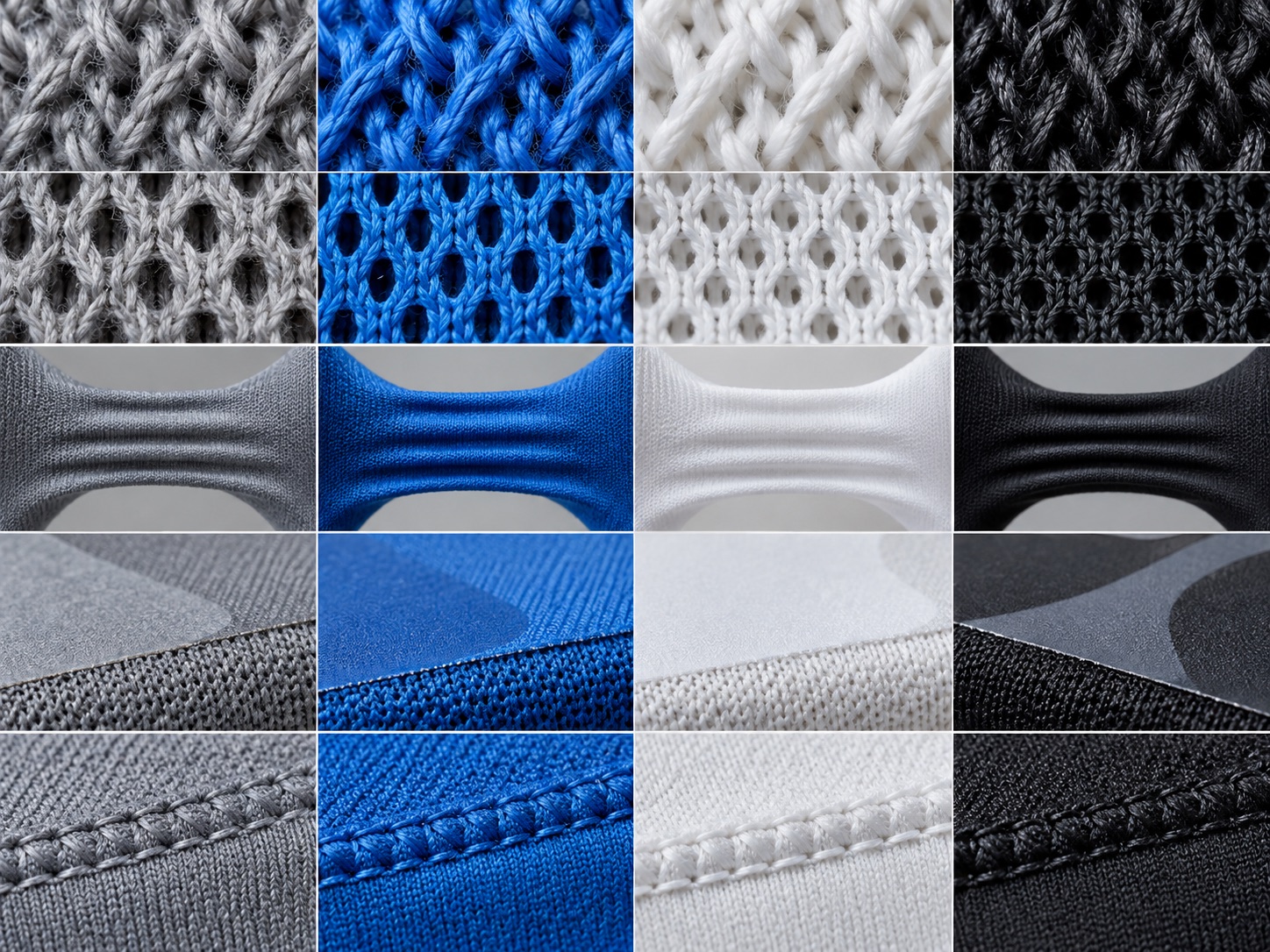
Inspect both faces and stretch directions. Note opening size, yarn appearance, surface texture, sheen, drape, edge curl, opacity and how the fabric recovers after extension. A macro image helps communication but does not replace the retained swatch. Ask whether the production material will come from the same lot or an approved bulk submission.
Fibre content alone does not predict garment performance. Yarn, knit geometry, finish, dyeing, print, panel orientation and construction all contribute. Avoid presenting a generic fibre claim as evidence for a finished jersey.
3. Use GSM as one controlled measurement
GSM means grams per square metre, a measure of mass per unit area. ASTM D3776/D3776M is one recognised route for determining fabric mass. A lower GSM does not automatically mean more breathable, faster drying or lower quality; two fabrics with similar mass can have different thickness, openness, absorbency and strength.
Ask how the quoted value was measured, whether it is nominal or tested, the tolerance and whether the swatch matches the production reference. Coatings, finishes and moisture conditioning can affect mass. Use GSM to compare controlled candidates and check consistency, not to create a performance grade by itself.
Evaluate the finished garment too. Double layers, collars, binding, transfers and large printed areas change local weight and air exchange. A fabric number cannot describe the complete wearing system.
4. Separate air permeability from moisture behaviour
Air permeability measures air passing through a material under defined conditions; ASTM D737 is a commonly cited textile method. Moisture management involves liquid interaction and transport, for which AATCC TM195 is one method. These are different properties. An open mesh may pass air readily while handling liquid differently from a finished smooth knit.
When reviewing a report, match the applicant, fabric reference, colour or finish, test method, units, conditions and date. A result for a similar fabric is background evidence, not proof for the offered lot. Ask what requirement or benchmark the result is being compared with; a bare number can sound scientific without supporting a decision.
Drying time, absorbency and wicking can also use different methods. State the wearer problem first, then select evidence. Avoid combining several properties into a single unsupported “quick-dry breathable” label.
5. Test the failures that matter after use and care
Potential checks include dimensional change, colourfastness, pilling, abrasion, snagging, bursting strength and appearance after laundering. Not every project needs every test. Choose from garment use, market requirements, previous failures and order risk. AATCC and ASTM catalogues identify established methods, but the buyer and laboratory must select the correct current procedure and criteria.
AATCC TM135 addresses dimensional change after home laundering under specified conditions. ISO 5077 is another dimensional-change reference. Record washing, drying, cycles, conditioning and measurement points. A casual wash can reveal a problem, but it should not be reported as a standard result without the specified procedure.
Consider print and seam interaction. Heat, ink coverage, transfers and needle damage can alter stretch, hand and recovery. Review a production-relevant printed and sewn sample, not only an unprinted swatch.
6. Check opacity, colour, print and fit on the garment
Opacity changes with colour, stretch, moisture and underlayers. Examine the garment under expected lighting and movement, using an agreed base layer where relevant. Light-coloured or highly stretched areas deserve specific review. Record the setup so the decision can be repeated.
For printed products, inspect fine detail, gradients, colour reference, show-through, surface change and artwork across seams. A smooth fabric can support detail differently from an open structure. Colour approval should use the agreed physical or controlled process reference; screens are unsuitable as the only critical standard.
Fabric stretch and recovery influence ease and measurement. A pattern approved in one material may not deliver the same fit in another. When changing fabric, identify affected measurements and decide whether a new fit or pre-production sample is required.
7. Create a fabric decision record suppliers can reproduce
Use a comparison table with candidate reference, intended product, structure, composition claim, mass, relevant test results, colour and print route, sample observations, risks and disposition. Link every report to the exact sample it describes. Mark supplier statements, observed findings and independent test evidence separately.
Approve the selected reference with retained swatch and garment sample where proportionate. State tolerances or approval routes for bulk colour, mass or performance, and require notice before substitution. If a claim has not been tested, describe it as a target or supplier statement rather than a verified result.
The best fabric file allows another buyer, technologist or inspector to understand why the material was chosen, what evidence supports it and which properties remain unverified.
8. Ask questions that expose evidence quality
Ask the supplier to identify the offered fabric code, production source, stock or made-to-order status, usual tolerance and test records that refer to that material. Request a sample-to-report link: who submitted it, when, in which colour and finish, and whether printing or laundering occurred before testing. If the answer uses a family report or a technically similar fabric, label the evidence accordingly rather than rejecting or accepting it automatically.
For each performance claim, write the decision threshold before viewing results. The threshold may come from product history, buyer specification, market practice or professional advice. Without an acceptance basis, buyers can compare numbers while still not knowing whether either fabric is suitable. Where no threshold exists, run a comparative development evaluation and describe the conclusion narrowly.
Finally, retain a bulk submission and check that production matches the approved reference within the agreed route. A laboratory value does not control colour, hand, surface and garment assembly by itself. Material selection and bulk confirmation are connected decisions.
When comparing suppliers, normalise units and methods. Results produced under different procedures or conditions may not be comparable. Ask a qualified laboratory or textile specialist when interpretation affects compliance or a high-value claim.
What to confirm for your project
- Wearer, conditions, fit and care use case
- Controlled fabric identity and retained swatch
- Relevant measurements and methods
- Report-to-sample traceability
- Print, opacity, seam and garment review
- Bulk tolerance and substitution notice
- Comparable units, methods, conditions and acceptance basis across candidate reports
MOQ, sampling conditions, production timing, exact material options and service scope are confirmed for the specific product and order. This guide does not replace a current quotation, approved sample or production specification.
Questions to carry into supplier review
- Which wearer problem is this property meant to solve?
- Does the report identify the offered fabric?
- What changed after print and garment construction?
- Which claim is tested and which is supplier language?
Questions buyers ask next
Is a lower GSM jersey always cooler?
No. GSM measures mass per area. Air permeability, knit openness, thickness, moisture interaction, fit, colour, print coverage and environmental conditions also affect comfort. Compare the actual candidates using properties linked to the use case.
What does moisture wicking mean?
It is commonly used for liquid movement away from a wet area, but suppliers may use the term loosely. Ask for the defined property, test method, sample identity, result and acceptance basis. Do not treat the phrase itself as a test result.
Can buyers judge fabric quality from a swatch?
A swatch supports touch, surface, structure, colour and limited stretch observations. It cannot fully show garment fit, seam behaviour, print coverage, wear or care. Use a finished sample and defined testing where those risks matter.
Should every jersey fabric have laboratory reports?
Testing should be proportionate to claims, market requirements, order value and failure risk. Existing relevant reports may help, but check traceability and scope. Some decisions can use specification and samples; regulated or critical claims may need current laboratory evidence.
What happens when the supplier changes fabric?
Require a change notice identifying the new reference and reason. Compare relevant specification, swatch, print, colour, measurements and test evidence, then decide whether a new garment sample is required. Give the approved change a new revision.
Technical references and question evidence
- Technical referenceASTM D3776/D3776M — Mass Per Unit Area (Weight) of Fabric
- Technical referenceASTM D737 — Air Permeability of Textile Fabrics
- Technical referenceAATCC TM195 — Liquid Moisture Management Properties of Textile Fabrics
- Technical referenceASTM International — Textile standards catalogue
- Technical referenceAATCC — Test methods, evaluation procedures and monographs
- Technical referenceAATCC TM135-2025 — Dimensional Changes of Fabrics after Home Laundering
Technical references support the discussion method. Question evidence documents public discussion of an issue; it does not diagnose a KITOEM product or establish a test result.