
The decision in one paragraph
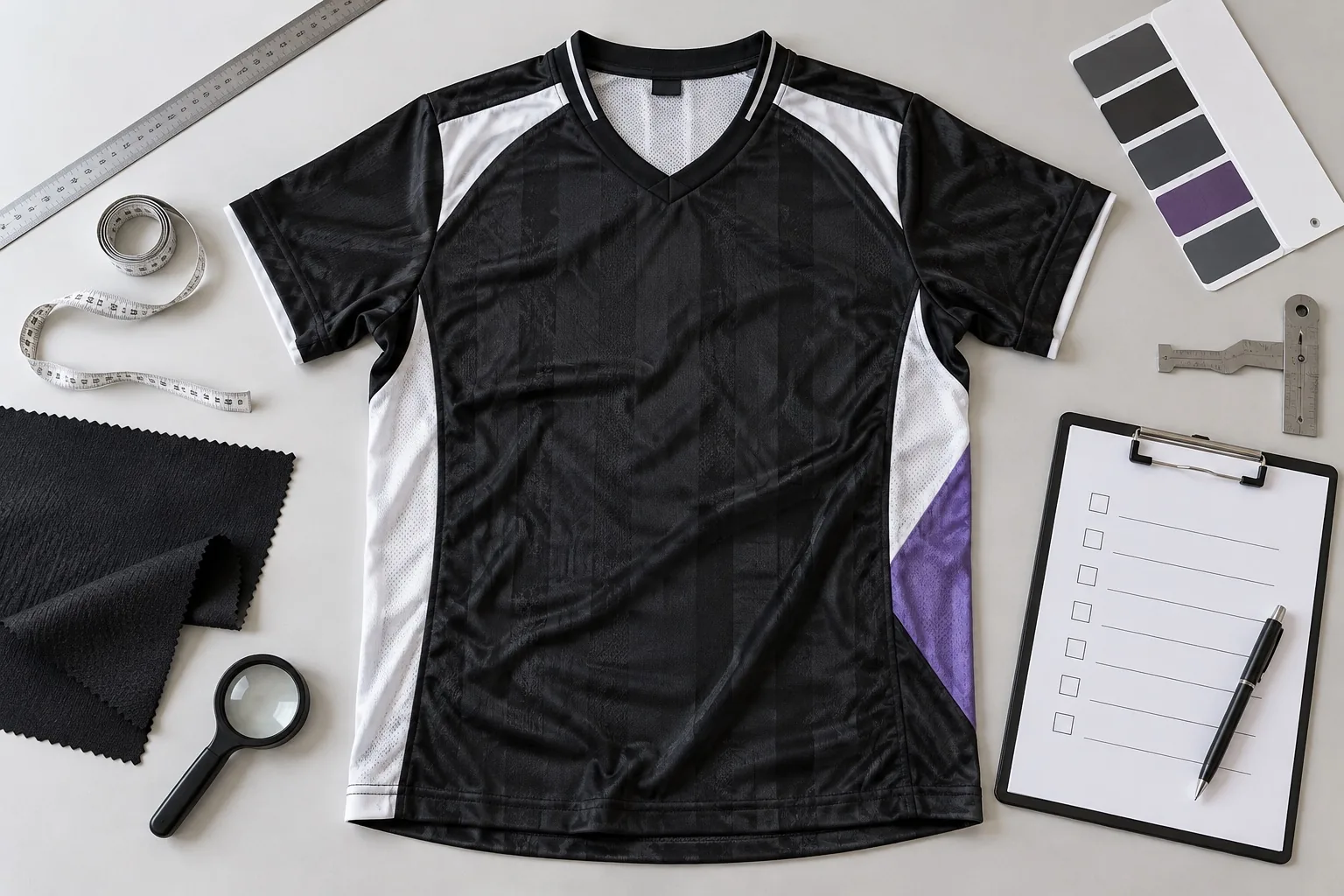
Before approving a bulk football jersey order, check six areas: fabric, measurements, seams, decoration, player details and packing. Compare each against the agreed specification and approved sample, and record any mismatch before authorising the next stage. A heavier fabric or a clean-looking sample alone does not establish bulk quality. This guide gives clubs, brands and distributors a practical inspection checklist, explains what a sample approval covers, and shows which requirements need separate testing or a written inspection agreement.
1. Inspect the jersey in a repeatable sequence
A repeatable order reduces missed checks and supports comparison between inspectors. The exact sequence can change, but the same approved references should be used throughout.
| Inspection area | What to compare | Examples of findings to classify |
|---|---|---|
| Identity and assortment | Style, colourway, size, quantity, roster, labels and pack group | Wrong style, missing size, duplicate number, mixed colourway |
| Fabric and panels | Approved reference, face/back, shade, hand, visible structure and panel orientation | Shade variation, wrong face, contamination, hole, snag, panel mismatch |
| Measurements and fit | Specified points, measurement method, tolerance and sample purpose | Out-of-tolerance chest, body length, sleeve or collar opening |
| Sewing and construction | Seam type, seam allowance, stitch formation, alignment and reinforcement | Open seam, skipped stitch, seam grin, twisting, puckering, raw edge |
| Artwork and decoration | Revision, colour, scale, position, registration, adhesion and roster data | Wrong name, lifted edge, ghosting, migration, misplacement, colour difference |
| Finishing and packing | Cleanliness, threads, pressing, folding, labels, bags, carton marks and counts | Stain, untrimmed thread, heat mark, wrong bag label, carton shortage |
2. Define quality as conformance to an intended use
A heavier fabric, more stitches or a more expensive badge does not automatically make a better football jersey. Quality begins with the right product for the use: match or training; adult or youth; close or regular fit; full sublimation or discrete decoration; frequent team laundering or individual care; first order or repeat programme. The specification should convert that use into controllable requirements.
Separate three layers of evidence. Established technical knowledge explains what a property or test method measures. General industry practice describes common sampling, approval and inspection approaches. Product-specific evidence identifies the actual KITOEM or supplier product, material, process and result. A standard listed in an article supports the method; it does not certify the jersey or factory.
Build a quality plan before the bulk order. It should identify controlled files, approval stages, responsible people, defect definitions, inspection timing and release authority. Without that plan, inspection tends to become a late visual search for obvious defects while unresolved specification questions are mistaken for workmanship problems.
3. Create the reference pack before inspecting anything
The inspector needs one current reference pack: purchase order or contract, product specification, bill of materials where applicable, measurement chart with points of measure and tolerances, approved artwork and placement, approved roster, colour reference, sample approval record, care information, packaging instructions and authorised changes. Every file should show a revision or date.
Identify what the approved sample proves. A fit sample may approve pattern and measurements but use substitute fabric or blank artwork. A colour trial may approve print reproduction but not sewing. A pre-production sample may represent more of the final construction but still does not prove bulk consistency. Record open points rather than allowing “sample approved” to imply more than was actually reviewed.
Use the same identity at every stage: style or product reference, colourway, size, artwork revision and roster revision. If the bulk carton or garment cannot be connected to the approved specification, even a well-made unit may be the wrong product.
4. Connect fabric claims to the right evidence
Start with observable identity: supplier fabric reference, claimed fibre composition, knit structure, colour, finish, lot and mass per unit area where specified. Do not infer composition or performance from appearance. If a buyer requires breathability, moisture management, pilling resistance or dimensional stability, define the property and method separately. One “performance fabric” label cannot stand in for all of them.
Dimensional change illustrates why method detail matters. ISO 5077 specifies determining dimensional change after a selected combination of washing and drying procedures, while ISO 6330 defines domestic washing and drying procedures used for textile testing. The buyer still has to select the relevant procedure, cycles, measurement points and acceptance criteria. A casual home wash can be useful development observation, but it is not automatically a standard test result.
ISO 12945-2 addresses pilling, fuzzing and matting using a modified Martindale method. The result for one fabric or colour cannot be assumed for every jersey. Choose performance checks from intended use, regulatory or buyer requirements, previous failures and order risk. Preserve the report-to-sample link and verify that the tested material matches the offered production reference.
5. Evaluate printing, decoration and sewing together
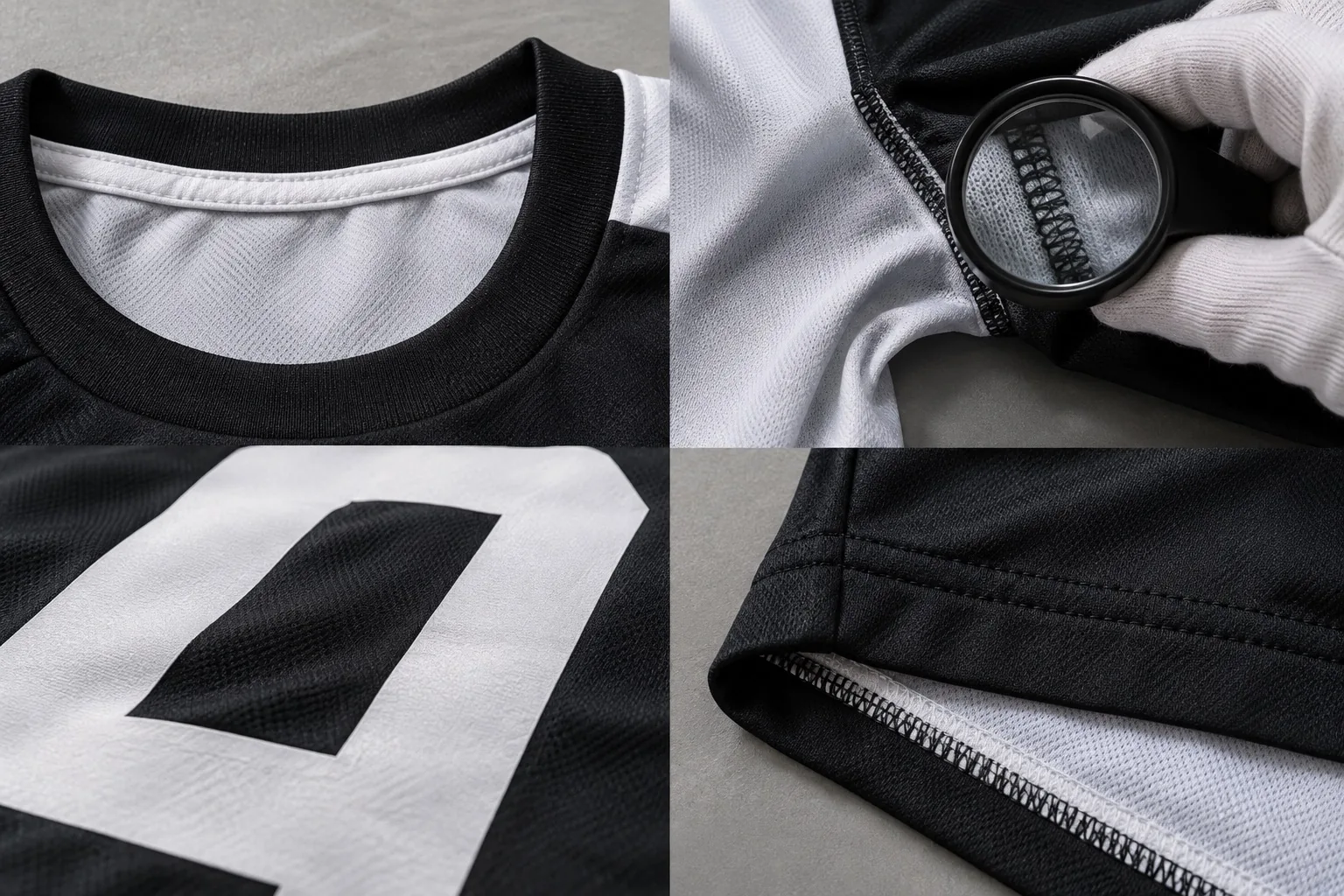
For sublimated panels, check solid areas, gradients, fine lines, unintended white gaps, ghosting, banding, colour variation, panel orientation and alignment across seams. For applied transfers, check position, scale, edge bonding, surface change, opacity, stretch and signs of dye migration. For embroidery or badges, examine placement, distortion, backing, edge finish and whether the surrounding fabric puckers. Only claim a method that is actually offered and evidenced for the product.
Inspect seams from outside and inside. Look for balanced stitch formation, skipped stitches, broken threads, unsecured ends, inconsistent seam allowance, needle damage, twisting, puckering and uncomfortable bulk. The correct seam depends on fabric stretch, garment construction and location. Counting stitches alone does not establish strength or comfort.
Pay special attention to stress and transition areas: collar joins, shoulder and underarm intersections, side seams, sleeve hems, bottom hem, badge edges and areas where a transfer crosses a seam. Check the smallest and largest production sizes because placement, proportions and machine access can change.
6. Understand what AQL sampling can and cannot do
ISO 2859-1:2026 defines acceptance-sampling schemes indexed by acceptance quality limit for lot-by-lot inspection. It can help determine how many units to sample and the acceptance or rejection threshold under an agreed plan. It does not set the jersey specification, decide which defects are critical, major or minor, or guarantee that accepted lots contain zero defects.
Before inspection, define the lot and how units will be randomly selected; the inspection level and sampling plan; the AQL values or other criteria by defect class; the defect list with photographs where useful; what happens when a lot is rejected; and who can authorise release or a concession. Do not quote an AQL number without the sample-size code, plan and defect classification.
Some checks may need different coverage. Buyer-specific roster accuracy, safety issues or legally required labels may justify 100% checking even when workmanship uses sampling. Measurements can use a separate size-based sample. Laboratory tests normally use their own sampling and conditioning rules. A quality plan can combine these controls rather than forcing every question into one AQL table.
7. Example: first bulk order for 300 personalised jerseys
Imagine a distributor placing a first order for 300 jerseys across ten sizes, two goalkeeper colourways and unique player numbers. Before production, the buyer approves the specification, printed and sewn sample, measurement chart, colour references and roster. The inspection plan treats wrong personalisation and wrong product identity separately from workmanship. It also sets a measurement sample across the size range and defines the bulk packing reconciliation.
At pre-shipment inspection, the inspector first confirms the lot and draws units under the agreed plan. The sample is checked for identity, fabric and shade, measurements, seams, print and decoration, finishing and packaging. Roster data may receive broader coverage because one wrong number can make a jersey unusable even if the garment is otherwise well sewn.
If a recurring seam opening appears, the right response is not merely to replace the sampled units. The buyer and supplier need to determine the affected scope, contain the lot, identify the cause, rework or remake under an agreed disposition, and reinspect as specified. The contract should identify who has authority to accept, reject or approve a concession.
8. What should buyers check and ask for?
- A controlled product specification, measurement chart and artwork/roster revision.
- A sample approval record stating what was approved, what was substituted and what remained open.
- Fabric and decoration references that connect any report to the actual offered material and colour.
- A written defect classification with visual examples for order-specific risks.
- The inspection lot, sampling plan, measurement sample and any 100% checks.
- A release, rejection, rework and reinspection process with named authority.
- Packing and quantity reconciliation by style, colour, size, player data and carton.
- Records needed for repeat orders: approved files, retained sample, material references and authorised changes.
9. Questions to ask your manufacturer
- Which controlled documents will govern production, and how will revision changes be acknowledged?
- What does each sample stage prove, and which materials or processes are still substitutes?
- Which fabric and garment properties will be tested, by which current methods and against what criteria?
- How are first-piece, in-line and final inspections recorded for this product?
- What defect classes and sampling plan do you propose for the finished lot?
- Which items will receive 100% checks, especially names, numbers and required labels?
- What happens when a repeated defect suggests that more of the lot may be affected?
- Which records and physical references will be retained for repeat orders?
What to confirm for your project
- Intended use and controlled specification
- Sample purpose and approval record
- Fabric, colour and decoration identity
- Measurement method and tolerances
- Defect classes and visual standards
- Lot and sampling plan
- 100% checks for order-specific critical data
- Rework, reinspection and release authority
- Packing reconciliation and repeat-order records
MOQ, sampling conditions, production timing, exact material options and service scope are confirmed for the specific product and order. This guide does not replace a current quotation, approved sample or production specification.
Questions to carry into supplier review
- What evidence proves the bulk matches the approved sample?
- Which failures matter most for the intended use?
- Which checks use sampling and which require full coverage?
- Who can release a lot after a defect or concession?
Questions buyers ask next
What should I check on a custom football jersey sample?
Check the fabric reference, garment measurements, seams, crest and sponsor artwork, names and numbers, and labels. Compare them with the same specification revision. Record substitutions and unresolved points, because a fit sample may not use the final fabric or decoration.
Does a higher GSM mean a better football jersey?
No. GSM describes fabric mass per unit area, not overall jersey quality. Assess weight alongside the intended use, fabric construction, fit, coverage and any required performance evidence. Choose a fabric that meets the agreed requirements rather than treating extra weight as proof of quality.
What if the bulk jerseys do not match the approved sample?
Document the difference against the approved sample and specification, identify which sizes or units may be affected, and notify the supplier before accepting the disputed goods. Agree the investigation, correction and reinspection steps under the purchase terms. A sample approval alone does not define the remedy.
What is a good AQL for football jerseys?
There is no responsible universal number. The buyer and supplier must define defect classes, risk, lot, inspection level and sampling plan. Legal, safety or roster-critical checks may require different treatment or 100% inspection.
Should buyers wash a jersey sample?
A care review can be useful, but define the wash/dry procedure, cycles, observations and criteria. If the result will support a formal claim, use an appropriate current method and traceable sample rather than describing an informal wash as laboratory testing.
How many jerseys should be measured?
Set the measurement sample from order risk, size range, pattern history and the inspection agreement. Make sure the smallest and largest sizes and relevant size runs are represented; this can be separate from the workmanship sample.
Technical references and buyer discussions
- Technical referenceISO 2859-1:2026 — Sampling schemes indexed by acceptance quality limit (AQL)
- Technical referenceISO 5077:2007 — Determination of dimensional change in washing and drying
- Technical referenceISO 6330:2021 — Domestic washing and drying procedures for textile testing
- Technical referenceISO 105-C06:2010 — Colour fastness to domestic and commercial laundering
- Technical referenceISO 12945-2:2020 — Modified Martindale method for pilling, fuzzing and matting
- Technical referenceASTM International — Current textile standards catalogue
Technical references explain the methods discussed. Public buyer discussions show how a problem is described in practice; they are not reports on KITOEM products or test results.